Deliberate mistake: In the scene where Bob and Charlotte first glance at each other in the elevator, the film has been reversed. 3 mistakes are visible. The first one is that the woman's Kimono is reversed, left side tucked into the right. All Japanese garments are always tucked in right side first. Only on the day of your funeral is the left side tucked in first. The second mistake is the lapel hole on Bob's jacket; it is shown on his right. The lapel hole is almost always on the left side of a men's suit or sport jacket. And in every other scene in the film, his lapel hole is on his left. The third is the birthmark by the ear and the 1 inch vertical scar on Bill Murray's cheek are shown on his right side. When in actuality, they are on the left side of his face. (00:08:00 - 00:08:35)
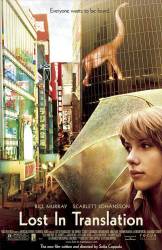
Lost in Translation (2003)
1 deliberate mistake - chronological order
Directed by: Sofia Coppola
Starring: Scarlett Johansson, Bill Murray, Anna Faris, Giovanni Ribisi, Akiko Takeshita, Kazuyoshi Minamimagoe


Continuity mistake: In the black toe scene when Bob and Charlotte are having lunch and Bob tells her about his massage, Charlotte rests her cheek on her fist, then the camera cuts back to Bob and Charlotte has her chopsticks in her hands, then back to Charlotte and her fist is up to her cheek again. (00:56:45)
Stills Photographer: Are you drinking, no?
Bob: Am I drinking? As soon as I'm done.
Trivia: Charlie Brown is an actual friend of Sofia Coppola. His real name is Fumihiro Hayashi and he owns a fashion magazine in Tokyo.
Question: In one of the Special Features on the DVD, it shows Sofia Coppola and the rest of the cast and crew fulfilling a pre-filming tradition of holding hands and saying a word that sounds like 'puaba' three times. Can anyone tell me what this word means and why it is a tradition in Sofia Coppola's family?
Answer: Her aunt, Gia Coppola, once said in an interview, the word is "Puwaba," which she believes is for good luck and she doesn't really know the meaning. So maybe Sofia doesn't know as well.
Answer: I believe the word, pùaba, comes from Corsican. It means "I did." Not sure if this is correct, but Corsica is near Italy and France, and she's Italian? Closest match I could find.
Answer: I believe that it means something like "good luck", as she hoped the production goes as smoothly as possible.