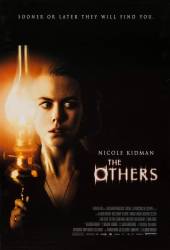
Question: So is Charles, Grace's husband, dead too or is this another example of the worlds of the dead and living colliding?
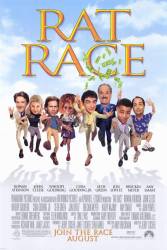
Question: Besides being played for comedic effect, would getting the coin toss wrong have really mattered?
Answer: It really would have mattered. This was over time and the winner of the coin toss gets the ball first. In 2001, NFL overtime was sudden death where a field goal wins the game. So having the ball first is a huge advantage. The messed up coin toss seems to be a joke about the 1998 Thanksgiving game between the Lions and Steelers where the ref messed up the coin toss in overtime because he heard the Steeler's player's call wrong. The Lions ended up getting the ball and winning. Not to mention that many people who bet on football games also bet on the coin toss.
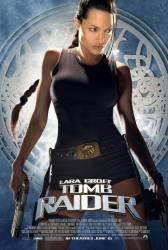
Question: The Director states in the commentary that there are some clues to some kind of puzzle at certain scenes (such as When Lara is doing the bungee ballet and when Alex gets knifed). What are these clues that we're supposed to be looking for - something in the background? The action? Some kind of composition? And just what is the puzzle?
Answer: This movie left a lot of holes. It was pretty much: Lara knew what to do and she did it. Perhaps there are clues in the movie, but the book explains all the puzzles in much more detail (as books do). So if you are really interested in the deep puzzles of the adventure, the Tomb Raider book is what you should look at.
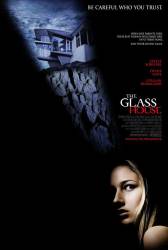
Question: Why did Terry and Erin put the kids in one bedroom at first? They had another room anyway, as is revealed when they suddenly make the new bedroom for Ruby, before the social worker visits. And if they want the kids to trust them, it would make sense to give a teenage girl her own room.
Answer: Terry told them when they first moved in that it was only going to be temporary so that they would think that they would eventually get separate rooms, but I think they always intended to keep Ruby and Rhett together in the same room so that they could easily monitor their movements. The only reason they quickly knocked up a second room (for Ruby) for when the social worker came, was to carry on the charade of being responsible guardians for them, and they knew if the social worker saw that a teenage girl and her younger brother were sharing, it would raise red flags, and they needed everyone to believe that they were responsible enough guardians, so that they could keep the kids and eventually get their hands on the trust.
Question: During the infamous lust scene, several times you see people's hands inside a bird cage. What is the significance of this?
Answer: Symbolism for trying to break free of her situation.
Question: The dad says Fenton is a demon, but demons were only people who have killed other people in their past, and Fenton hasn't killed anyone yet. It is later in the movie he kills his dad, so how did his dad know he was a demon?
Chosen answer: Paxton is obviously mentally deranged so he can call anyone a demon and find a way to justify it.
This answer is entirely incorrect. If you watch the film, you realise that it is only Fenton's belief that his father is insane. In the reality of the film, everything his father has told him is true. He is in fact a "demon killer." Since there is no explanation in the film as to what actually makes someone a demon, it's safe to assume the angel knew Fenton would grow up to become a serial killer. The father refused to believe his own son would be a demon, and so tried to force him to "see" the truth.
It really isn't "in the reality of the movie" - it is in the dad's psychotic mind (his warped sense of reality). What sane father, for example, would subject his children (preadolescents at that) to chopping people up with an ax, have them help dig graves and bury those killed, lock his 12-year-old son in a "dungeon" with no food and only one cup of water a day, check on his son after a week but nail the door closed again for another (apparently long) period of time? And I don't think Fenton became a serial killer - Adam was the serial killer (maybe of demons in his warped mind). The father seemed to assert that Fenton was a demon because he was not supporting him in killing people ("destroying demons"). Why didn't the father view Adam - who could be viewed as killing his own mother during childbirth - as a demon? Adam, being younger and more impressionable, agreed with the father but was also told they were like "superheroes" - what young kid could rationally discern the difference?
The cartoon shown on TV ("Davy and Goliath") offers additional evidence that the father was not destroying demons. "Davy" asks his father about God, and his father tells him that "God doesn't make you do anything" and wants you to decide. Even IF God or the angel sent someone a list of demons to destroy, it would be up to the person to decide whether or not to destroy the people. I know that the purported acts of the people that were killed were revealed when the dad (or Adam) put his hand (s) on them, and that viewers were then supposed to believe that they really were destroying demons, but the view that they were just hallucinating is still valid.
I think the movie allows the viewer to make his/her own conclusion - is the father really destroying demons or is he a cold-blooded murderer? There is sufficient reason to believe the father had a psychotic breakdown or something similar and, instead of destroying demons, was a serial killer. There was no evidence of any others being chosen by God to destroy demons, no indication that the world was coming to an end, and no reason to murder the sheriff who was leaving and said he didn't believe one bit of what Fenton told him about the killings. Besides, wouldn't God protect the father from the sheriff if He protected Adam from being detected by the FBI agents and cameras? For what it is worth, I disagree with the comment by Jason below and think your view is more accurate.
There are several important factors that show the father (and son) are actually fighting demons: The "help" they frequently receive, like ALL of the surveillance tapes not showing Adam's face when he's hunting a demon (This can hardly be dismissed as coincidence, as they all look fine except wherever Adam's face would be visible), the FBI agent at the end who inexplicably can't describe Adam and doesn't recognize him when they meet again, the fact that the victims are stunned after the father or Adam touches them with a bare hand to reveal their sins, etc.
I'm aware of all of those things, but videotapes used to do that - maybe if the FBI agents tried fixing the alignment his face would show. Adam looked different to me, too - his hair looked redder than when he was at the FBI office. Of course victims would be stunned and scared when a lunatic grabbed them. I do understand what you are saying, but I still don't think it is enough. Surely there were far more "demons" out there; the number of killings was relatively small. And, again, Davy said that God doesn't make anyone do anything - He wants the person to decide.
The point with the video tapes is that they say ALL of them are like the one, with the image only messed up across his face, and only when his face is visible. I suppose this is just an agree to disagree issue. You don't see these things as enough, while I see them all combined as more than enough. Interesting discussion of a good movie either way.
I was thinking of writing something like that to you! And now I can agree with something you wrote!
Question: What is written on the rear window in a foreign language?
Answer: You do not specify to which scene you are referring. The only window I recall with writing on it would be the window in Nash's room. John had covered this window in mathematical equations, theorems and geometric patterns. While most of the symbols used are Greek in origin, the language is simply that of mathematics.
Question: In the scene where Jimmy and his friends are finding their parents again, who is driving the cargo ship they're on?
Answer: Surely such an advanced spaceship would have some form of autopilot.
Question: Why do characters in this movie have such a strange names, like Azrael, Brodski, Kinsa, Stoney, Gecko and others?
Answer: It's set nearly 500 years in the future. Naming conventions change.
Answer: Actually internet names of friends of Todd Farmers.

Question: At the beginning of the mehndi party we can see a servant frying something - supposedly some sweets -, by pouring liquid batter into boiling oil though a bowl with a hole in the bottom. What is the name of the sweets he prepares?
Answer: The sweet he prepares is called 'jalebi' and it is exactly as you say, batter fried in boiling oil. It is poured through the bowl with a hole at the bottom to get its distinctive swirly pattern. Once cooked the batter is dipped in sugar syrup to make it sweet.
Question: Despite Dr. Mark Powell's certainty that "Prot" is a delusional man named Robert Porter who lost his mind and attempted suicide years earlier, no explanation is ever given for Prot's extraordinary resistance to powerful psychiatric drugs, his superhuman vision (into the Ultraviolet range), and his knowledge of deep-space astrophysics, which not only rivals but exceeds the knowledge of Earthly astrophysicists. Prot's enigmatic abilities are tested by experts, and the experts are left scratching their heads. The probability that Prot actually is an alien entity occupying a deeply-damaged and "discarded" human body seems confirmed on many levels, above and beyond the rantings of a mere mental patient. So, why does Dr. Powell consistently reject the hard evidence before his eyes?
Answer: He rejects it for two main reasons. First, each of the items you mention have possible, even if unlikely, explanations. Some people have strange or no reaction to certain drugs (for example I have almost no response to any painkillers). People who have had their corneas replaced with artificial lens can see near ultraviolet (though nowhere near 300-400 angstroms). The sheriff described Porter as being very bright, and he was in to astronomy, so while a great stretch, not impossible he somehow formulated the information he presented. The second reason, building upon these, is Occam's razor. As a person in the sciences, Dr. Powell is driven to believe things have a reasonable explanation, even if we don't currently know what it is, and thinking Prot is just a bright and unusual human is a more reasonable belief to him than believing Prot is an alien possessing a human's body.
Just remarking, there's no comparison of painkillers and psychiatric drugs. Thorazine and Haloperidol (Haldol) are both powerful anti-psychotic drugs with numerous side effects. Prot is immune to Thorazine and Haloperidol (as well as alcohol), which is more than extraordinary, it's otherworldly.
Question: What is Dr. Casares' first name? A clue was his handkerchief which had his initials.
Question: Where do the Martins live, because one website says Hatfield, another says by the M25 and another says North London?
Answer: They are all the same place. They do live in Hatfield, which is North London, and London is surrounded by the M25.
Question: All the easter eggs mentioned in the Matrix Revisited section are not really easter eggs on my version of the film. Is this because I own the American version, and the easter eggs are on the UK version? All so, The Matrix trailer is not included in my version, even when I try the easter egg mentioned in the Matrix Revisited section it does not work. Can somebody tell me where I can see the trailer?
Answer: I also own the American version and I have the easter eggs. It could just be your specific copy that does not have them. And if you happen to have the Ultimate Collection I'm pretty sure you can see the theatrical trailer for it there. Or you can search for it online and you'll probably find it.
Question: What is the song that is played at the end of the film. (When the credits come up.) (Starts something like: "A man down under . . . ")
Answer: It's 'Down Under' by Men at Work.

Question: On the DVD, there are two sets of subtitles. One follows what is being said closely and includes sound effects. The other follows the general idea of what the characters are saying, but the sentences are written differently. What is the purpose of the second one? Also, why do even the accurate subtitles show Lin as Rin, Zeniba as Zaneba and Kohaku River as Kalaku River?
Chosen answer: This is probably because one track follows a near direct translation from Japanese, while the other subtitle track follows Japanese more loosely but is one that a westerner can relate to better. A normal western person who never had any experience with Japanese would be puzzled why there are sound effects in the text, that is because Japanese has a lot of specific sound effects for many thing, like the sound of someone walking and makes a quick stop, the sound of someone becoming shy etc. And as with Lin and Rin, these are pronounced the same way in Japan.
Question: I'm looking for the title and performer of one of the songs from "Lost and delirious"; it's played when Paulie is going to visit the bird for the first time, and then the same song is played again when the credits roll. I've tried most of the songs listed in the credits but I haven't found the one I'm looking for. Can anyone help me?
Answer: It is apparently an original work called 'Ensemble vocal d'Outremont' by Foley artist Jérome Décarire. Foley is the sound effects used in film and television production. For example, a foley library consists of a data bank of available sounds. A foley technician will create sounds that do not exist in the library.
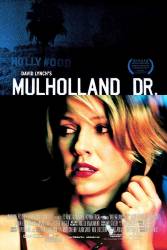
Question: Can somebody please explain to me everything that happened in Mulholland Drive? What is up with the bum behind the diner, the little people chasing Naomi Watts at the end, who is who, what is the key for? Ideally give a website reference which has a full answer, as a full answer will dominate this page.
Answer: There is no one right answer. See http://film.guardian.co.uk/features/featurepages/0,4120,634856,00.html for some theories from movie critics.
Answer: Naomi Watts killed her lover, Laura Harring, rather than lose her to someone else. She felt such guilt, she created an alternate reality using everything and everyone she knew, to create a happy and peaceful world. But the real world was sneaking in and the key was to unlock her blocked memories.
Chosen answer: He is dead, but he has accepted it. He spirit is going to Heaven or Hell and has stopped to say goodbye to his wife and children on the way.
Grumpy Scot