A Plaque for Mayberry - S1-E25
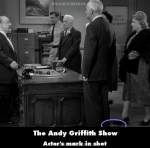
Visible crew/equipment: While everyone's waiting for Otis to arrive at the plaque presentation in Mayor Pike's office, after Andy admits to the mayor that he asked the real Otis to show up, it cuts to the mayor walking behind his desk, and we can see the chalk T-mark on the floor where Mrs. Bixby stands.
A Plaque for Mayberry - S1-E25
Visible crew/equipment: When Andy and Barney walk into Mayor Pike's office, they stand beside the two women from the Historical Society, and the faint chalk curved marks are visible on the floor where they stand.
A Plaque for Mayberry - S1-E25
Continuity mistake: About 2/5 through the show, Barney comes into the office with a family tree chart. The edge of the paper is on the bottom of the roll sticking out to the left, there's a cut to a different angle and the edge of the paper is on top, not sticking out and still facing to the left. On top, it should be facing to the right.


Answer: As noted in the previous answers, in real life, things like this provided wind and/or rain deflection, and also maintained a bit of privacy when blinds were raised somewhat. The interior courthouse set was located in the studio, so the "outside" Main Street didn't exist. I believe these things were added to the courthouse windows for practicality, to avoid some crew movement being visible on the opposite side of those windows. These are not "window boxes" to hold anything, as they're actually bottomless; we can see the Venetian blind's long pull cords under them. They're made of plywood and simple to build, so the "material and labor" was inexpensive. Similar variations made of different materials are in other movies/shows. In 1957's "12 Angry Men," textured chicken wire glass panels are in the jury room windows, and in "Jesse Stone: Night Passage" another type is in Jesse's office windows.
Super Grover ★