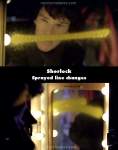
A Scandal in Belgravia - S2-E1
Other mistake: While Sherlock sits reading the paper he gets a text alert from (we assume) Irene Adler, and John notes that he had heard this alert fifty seven times. At the end of the episode, when Sherlock is looking through the texts that she sent to him, there are not that many texts from Miss Adler.
Suggested correction: There are 17 texts shown, but nothing indicates that that’s all he ever got. Probably his phone only displays the last few texts.
Plot hole: For the supposed code that hacks into UK system, Sherlock deduces that the finger taps are counted as 1s in the binary code and the rest (while Moriarty's fingers are in the air) are taken as 0s. Sherlock can't know the rate at which the rests are counted in the binary code that he thinks Moriarty tapped out. So even if the key code was real, he wouldn't have known what it was.
Suggested correction: I think you could figure it out, assuming the rests are all approximately the same length, which is also similar to the tap length, which is how most people would intuitively try to tap a binary code. As there can only be whole numbers of 0s, there can't be that many possibilities for the code. Also, if Moriarty wanted Sherlock to find the code, he would have taken care to make it deducible.
Character mistake: While the original Sherlock Holmes is famous for making water-tight deductions, the one in this episode does not quite live up to that standard. He declares someone a "compulsive cheat," because: "Waterproof cover on his smartphone. Yet his complexion doesn't indicate outdoor work. It suggests he's in the habit of taking his phone into the shower with him, which means he often receives texts and emails he'd rather went unseen." There are far too many problems here. (1) The only type of complexion that indicates outdoor work is sunburned. We don't have water-soaked or snow-frozen complexions. So, yes, he might work outdoors. (2) Indoor work may also deal with water, e.g. plumbing, dish washing (note what the accused man is doing!), water purification, lab work, etc. (3) Some people might just purchase a waterproof cover as a precaution. Some might receive it as a gift. Some may receive it free during a bulk purchase. (4) Not everyone who takes his or her phone into the shower has fidelity problems. They might want to listen to music, be up-to-date with the stock market, or, if I may use a euphemism, might want to have some quality alone time. (00:12:35)
Suggested correction: To (1): He probably meant outdoor work as a profession, not on that very day. If someone is outdoors a lot, it shows on the skin (more wrinkles, tan lines - the guy is quite pale, generally rougher skin). But he could just have started outdoor work a few weeks ago, plus all the other points.
Character mistake: Lestrade mentions that there could be some "poor sod covered with semtex on the streets somewhere" when talking about Moriarty's victims, but semtex does not go off via gunshot, much like C4. But that is what happens when one of the victims dies however, so the explosives are not semtex.
Suggested correction: The term "Semtex" is often used to refer to any plastic explosives, much like the term "Hoover" for a vacuum cleaner or "Kleenex" for a tissue.
But that doesn't negate the mistake.
Other mistake: Watson never orders, but somehow while in Angelo's, he has a full plate of pasta.
Suggested correction: Angelo feels so grateful because Sherlock saved him once that he immediately puts out food for him and his friend without being asked and without charging, in a 'here, have some' way.
Factual error: The entire reason Sherlock takes up the case is because he is intrigued how a man managed to disappear from a tube carriage in between stations - it appears to be impossible to do. However, any Londoner will tell you that it is perfectly simple to do: all tube carriages have doors between them linking them. So if the man wanted to leave the carriage between stations, he'd just use the door at the end of the carriage. The train employee would not be puzzled by this, nor would Sherlock consider the case worthy of his time.
Suggested correction: The footage we see doesn't show much of the interior of the last car, so if they get from that that nobody is in the car, they must have checked the interior somehow, which isn't shown or mentioned, and likely they checked the entire train. So the reasoning is: one man gets on the train at point A, the train is proven empty at point C (not shown), but at point B, the only possible exit in between, nobody got out.