Corrected entry: Barney is only a deputy but I'm sure makes a decent wage, however he lives like a poor college student, I'm sure rent can't be that expensive in a small town like Mayberry.
The Andy Griffith Show (1960)
1 corrected entry in show generally
Starring: Ron Howard, Don Knotts, Andy Griffith, Frances Bavier


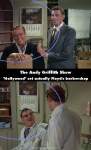
The Taylors in Hollywood - S6-E8
Revealing mistake: While Andy, Aunt Bee, and Opie are at the Hollywood studio watching a scene being filmed, when Andy mistakenly stands up and interrupts the filming we can see the wall and shelves behind the director, and it should look familiar because it's the wall and shelves from Floyd's shop in Mayberry.
Opie's Group - S8-E9
Andy: Clara, sometimes a parent can't see what he should do, and sometimes it takes a person from the outside to show him. And I'd like to thank you.
Clara: Groovy.
Trivia: When Gomer and Barney are waiting at the Miracle Salve Co. Office, Barney speaks in a nasally high pitch voice. When Gomer asks Barney what's the matter with his voice, Barney explains that he's been talking like that as a disguise, to which Gomer asks, "How do you do that? I wish I could do my voice like that!" Jim Nabors does precisely that for his role as Gomer.
Question: Beginning with the "Convicts at Large" episode in season 3, full width window boxes appear at the bottom of both front windows on the inside of the Sheriff's Office. Prior to this episode, they did not exist. Window boxes are often used to display decorative plants but I don't see any plants. And if they were supposed to partially block the background, the blinds were long enough to accomplish that. I find it hard to believe that the producers would spend additional money (for material and labor) for something that seems to serve no purpose. So why were they added?
Answer: As noted in the previous answers, in real life, things like this provided wind and/or rain deflection, and also maintained a bit of privacy when blinds were raised somewhat. The interior courthouse set was located in the studio, so the "outside" Main Street didn't exist. I believe these things were added to the courthouse windows for practicality, to avoid some crew movement being visible on the opposite side of those windows. These are not "window boxes" to hold anything, as they're actually bottomless; we can see the Venetian blind's long pull cords under them. They're made of plywood and simple to build, so the "material and labor" was inexpensive. Similar variations made of different materials are in other movies/shows. In 1957's "12 Angry Men," textured chicken wire glass panels are in the jury room windows, and in "Jesse Stone: Night Passage" another type is in Jesse's office windows.
Answer: Those "boxes" are valences that used to be very common, before air conditioning. They allow for windows to be open during rain storms. They permit air circulation, without letting the rain in.
Answer: I suspect these were common, as to block the wind from blowing the blinds and papers on the desk.
Correction: How much Barney makes is never discussed, so this is purely speculation.
Andy's salary isn't mentioned either but he lives a descent middle class life. Barney has to make something, but he doesn't spend it on a family or hobbies, he doesn't travel, doesn't own a car, but lives just one step above a homeless person.
hifijohn
This is not a plot hole. And I don't think Barney "lives just one step above a homeless person" whatsoever. We don't know Barney's salary, but he seemingly chooses to live a frugal lifestyle. We know Barney's expenses include rent, food (he eats out all the time), dates with girlfriends, etc. We see in S1 "Runaway Kid" Barney owns a car which has its own expenses. In S2 "The Clubmen" Barney says he sends his mom money every month. In S3 "Barney's First Car" (it was actually his second car on the show) Barney withdrew $300 from his bank account to buy a car, so we know he's been saving money, and we learn that some time in the past he had purchased a septic tank, which was expensive, for his parents' anniversary present.
Super Grover ★
Something else to consider, Don Knotts was born in 1924. Assuming Barney is supposed to be the same age, that means he grew up during the Great Depression. Many people from that generation tend to be very frugal.
Truthfully Law Officers are disgracefully underpaid but believe they used this fact to create Barney as a penny pincher. Barney is an excellent tightwad. He advises Thelma Lou to order "The Special" at the diner on a date. And collects from her when he picks an item up from the market for their supper. When it came to someone in need... remember how money came flying off his person to raise money to save the Lester Scobey house from foreclosure? It's only make believe.
Barney paid $5/week to Mrs. Mendelbright to stay at her boardinghouse - So $20/month. Barney would definitely be considered middle class. My Dad was a Deputy Sheriff during the early 60s to the mid 70s. To his recollection, his pay was roughly: Junior Deputy: $275/month. Senior Deputy: $325/month. Chief Deputy: $425/month. Dad said the Sheriff earned $600/month. Everyone earned an additional $125/month car allowance and an additional $1000/year for travel, uniforms and other incidentals.