Continuity mistake: When Lamarr gets out of the cab at the Chinese theater there is nobody near the cab, but when the shot of him getting out of the cab is shown, a man has suddenly appeared on the right side of the frame.
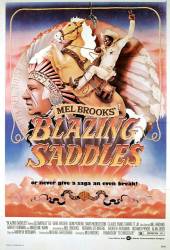
Blazing Saddles (1974)
Trailers
Directed by: Mel Brooks
Starring: Gene Wilder, Mel Brooks, Slim Pickens, Cleavon Little, Harvey Korman
More trailers


More mistakes in Blazing Saddles
Jim: Well, it got so that every piss-ant prairie punk who thought he could shoot a gun would ride into town to try out the Waco Kid. I must have killed more men than Cecil B. DeMille. It got pretty gritty. I started to hear the word "draw" in my sleep. Then one day, I was just walking down the street when I heard a voice behind me say, "Reach for it, mister!" I spun around... And there I was, face-to-face with a six-year old kid. Well, I just threw my guns down and walked away. Little bastard shot me in the ass. So I limped to the nearest saloon, crawled inside a whiskey bottle, and I've been there ever since.
Trivia: When Lamarr tells Le Petomane that his name is Hedley Lamarr and not Hedy, Le Petomane says that since it's 1874, Hedley could sue her. In 1974, actress Hedy Lamarr filed a lawsuit against Mel Brooks claiming the joke infringed on her privacy. The lawsuit was settled out of court.
More questions & answers from Blazing Saddles
Answer: Shvartses! (Blacks!) No, no, zayt nisht meshuge! (Don't be crazy!) Loz im geyn! (Let him go!) Cop a walk, it's all right. Abi gezint! (As long as you're healthy!) Take off! Hosti gezen in dayne lebn? (Have you ever seen such a thing?) They darker than us! Woof!
Greg Dwyer