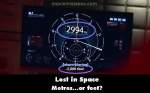
Lost in Space
Upvote valid corrections to help move entries into the corrections section.

Suggested correction: I didn't see anything they could use to dig their way out. Plus Don was on the other side, so they knew they could just wait.

Bishop73

Infestation - S1-E3

Stupidity: So "Dr. Smith" runs into her sister's boyfriend on the Resolute and pushes him into an airlock when he figures out who she is. The door immediately closes and a countdown to purge the airlock ensues. Who would design an airlock to do that? What if someone went in there by mistake or was doing some maintenance on it? To make it worse, there's no override inside the airlock? It's located in the corridor.

mikelynch

Lost in Space mistake picture

Impact - S1-E1

Other mistake: Right at the start, as they're crashing, the computer narrates their rapidly-dropping altitude in feet. But the "altitude" dial we're shown is in metres. Most noticeable as they cross the 3,000 mark, when the computer voice and the height say/show the same number at the same time, despite the different units. 3,000m would be more like 9,000 feet, or 3,000 feet would be more like 1,000m. (00:03:20)

Jon Sandys

More mistakes in Lost in Space

Resurrection - S1-E9

Penny Robinson: Just so I'm clear, we spent the night in what is essentially an alien toilet?

Bishop73

More quotes from Lost in Space

Trivia: The actor portraying the real Dr. Zachary Smith (who June Harris impersonates as "Dr. Zoe Smiith") is Billy Mumy, who played Will Robinson in the original 1960s TV series.

raywest

More trivia for Lost in Space

Infestation - S1-E3

Question: If the universe is around 13 billion years old, can the distances between galaxies be counted as a different units? Galactic distance is huge; could the distances be in trillion light years apart? I believe the age of the universe is different than galactic distances?

Answer: Yes to all questions. The best theoretical estimate is that the universe is about 7 trillion light years across. That is about 250 times larger than the currently observable universe. So, yes, using trillions of light years as a unit of measure is appropriate. And, yes, the age of the universe is a measure of time, and the space between galaxies is a measure of distance.

More questions & answers from Lost in Space