Revealing mistake: In the final 1/2 hour there's a scene in which Kevin Bacon is drifting weightlessly in the lunar module, with a roll of duct tape floating nearby. Just during the last couple of seconds of this shot, suddenly he & the roll accelerate to the right. As everyone now knows the zero-g scenes were photographed on-board an aircraft which flies free-fall arcs for up to about 20 seconds before having to level off. The sudden acceleration on the set means that shot was filmed just as the plane was leveling off from a dive. (01:53:40)
Apollo 13 (1995)
1 revealing mistake
Directed by: Ron Howard
Starring: Tom Hanks, Ed Harris, Kevin Bacon, Bill Paxton, Gary Sinise


Factual error: When Lovell's daughter is complaining that the Beatles have broken up, she slams the album Let It Be into her rack. The scene takes place on the day of the initial explosion aboard Apollo 13, April 13 1970 - immediately prior to the Lovell family attending the screening of a television broadcast from the spacecraft. Let It Be was not released as an album until May 9th, 1970. In April Ringo was still recording drum tracks, not even possible for an advance copy to get out.
Marilyn Lovell: Naturally, it's 13. Why 13?
Jim Lovell: It comes after 12, hon.
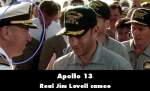
Trivia: The Captain of the Iwo-Jima who Tom Hanks talks to at the end of the movie is the real Apollo 13 astronaut Jim Lovell.
More questions & answers from Apollo 13
Answer: Spacecraft re-enter Earth's atmosphere at extremely high velocity (thousands of miles per hour). Atmospheric friction slows the spacecraft descent somewhat; but, without parachutes, the Apollo spacecraft would still reach the surface traveling at hundreds of miles per hour. Landing in water at such high speed would be like hitting concrete, which would of course be instantly fatal. Hence the necessity of multiple parachutes. The Apollo program (and all early U.S. manned space programs) chose to land in the ocean for two reasons: 1) It was easier to track spacecraft re-entry from horizon-to-horizon at sea without visual and radar obstacles, and; 2) It was faster and easier to position several Navy vessels in the general splashdown location, then deploy helicopters to rapidly retrieve the astronauts and their spacecraft.
Charles Austin Miller