
Continuity mistake: During the credits, while the young kids are racing the military car, the jeep behind always has a roof, as seen in all the outside and inside angles. However, in barely half a second, when the cars turn towards the base, the jeep has no roof.
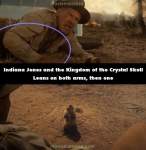
Continuity mistake: When Indy exits the fridge after the blast, he leans on both of his arms and faces a gopher. From a different angle, he is leaning on his left arm only.
Continuity mistake: In the race between the soldiers and the youngsters in the roadsters, there is a shot of boots on the military vehicle's pedals and the next shot is of sneakers on the same pedals.
Continuity mistake: While Mutt's bike is sliding along the library floor, right before it comes to a stop it's pushing a chair on the right. A frame later the chair has magically made a 180º turn and moved half a meter to the right.


Answer: People felt it was ridiculous and cartoonish, even by Indiana Jones standards. Even if it was possible to survive a nuclear blast via the lead lining of a fridge (it's not), or that the fridge would simply be thrown away rather than be melted/torn apart like everything else in the vicinity (it wouldn't), the impact of being flung what appears to be a mile or so through the air, then violently crashing into and rolling over the ground, would certainly kill anything inside. The controversy arose because usually, in "classic" Indy films, the fantastical elements were exactly that: fantastic, magical, and/or supernatural. This was presented as taking place in our reality, with no "power of God" or magic spells, and for many, that was just too much disbelief to suspend.