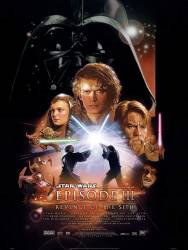
Question: Did Mace Windu actually beat Palpatine in their lightsaber duel or did Palpatine let him win? Also, is Palpatine's scarred face his "true" face or was it caused by the force lightning?
Question: Is there any text or info on what happens to all the droid armies and the Separatist organizations that have been rendered leaderless, after the end of Episode III?
Answer: The droid armies were shut down by the Separatists, rendering them inert; they would presumably have been subsequently collected up and dismantled by the victorious Empire forces. While some other Separatist organisations would have remained active, without the droids that formed the vast majority of the Separatist strength, they would be effectively nullified as any sort of threat, so they would likely go dormant or underground.
Question: After discovering the slaughter of the apprentice Jedi at the Jedi Council, why do Yoda and Obi-Wan decide to fight Palpatine and Anakin separately? Palpatine was ready at hand, at the Senate, while Anakin was in distant Mustafar. Stategically, it seems to me this would be their best option - Yoda loses the fight to Palpatine but not for much, managing to survive and flee; he most likely would have been able to win had Obi-Wan fought along. Then, Anakin would have certainly been defeated - the loss of his master impacting on him. If I understood it all correctly, this would have saved the Republic and allowed them to rebuild the Jedi Order from scratch (but not made any sense with IV, V, VI, which is why they didn't do it). But is there any in-plot explanation?
Answer: It boils down to the element of surprise. The clone troopers have shown that they're entirely capable of dealing with Jedi by that point - if either Palpatine or Anakin is able to surround themselves with a large and alerted clone trooper force, then Yoda and Kenobi will have no chance to get near them and that's game over. With Anakin seperated from his master, they're vulnerable, but if both Jedi attacked one target, the other would be alerted to the fact that Yoda and Kenobi had survived Order 66 and could take steps to protect themselves and unleash the military to hunt down their adversaries. By dividing their strength and attacking their targets simultaneously, Yoda gives them their best shot of taking out the Sith for good.
Question: I've read that Anakin joined Palpatine because he felt remorse over the death of Windu and that he would have been expelled from the Jedi order for sure. Couldn't he have just lied and said that it was Palpatine that killed him and that he played no part in it?
Chosen answer: No, because it's wrong. Anakin joined Palpatine not out of remorse or fear of being expelled from the Jedi Order, but because he thinks that, with the Sith Lord's help, he can save Padme from dying. If he turns Palpatine in, he believes that she'll die and that's not an option for him.
Question: If Obi-Wan could defeat Anakin then why couldn't he defeat Dooku?
Chosen answer: Dooku didn't fight Anakin at his full strength in his final duel. The plan, as Dooku understood it, was to turn Anakin to the Dark Side, not to kill him. After defeating Kenobi, which he did relatively easily, he held back, prolonging the fight and taunting Anakin, trying to get him to tap into his anger and hatred. He believed that, once Anakin succumbed to temptation, that Palpatine would step in to stop the fight, reveal himself as a Sith Lord and complete Anakin's induction into the Sith. As such, he wasn't fighting to win, merely to prolong the fight as long as it needed to be to serve their purposes. Effectively, he took a fall against Anakin, believing, incorrectly, that his Master would save him. As such, you can't use Anakin and Obi-wan's fights against Dooku as a reliable indicator of their respective power levels.
Question: Why did Yoda leave for exile after his duel in the senate with Palpatine? Why didn't he continue fighting?
Chosen answer: Because he came to the conclusion that he couldn't win, so the best solution, long-term, was for him to hide away somewhere to be ready to help prepare the next generation for the fight. If he continues the fight, he risks his own death and the loss of his ability to pass his knowledge on later, which could leave the galaxy under Sith rule forever. If he runs, then the Sith will rule for a time, but there's a far greater possibility that the Jedi will eventually be able to rise again and defeat them.
Question: I don't know if there is an answer to this, but what did Dooku think was going to happen on the ship above Coruscant? It seems like he was supposed to kill Anakin and Obi-wan, but if he had managed to do that, there wouldn't have been a way for Palpatine to be "rescued" from him and Grievous. Was Dooku planning to let them escape eventually?
Answer: Dooku believed that the intent was that he would slay Kenobi, with the aim of provoking Anakin into enough of a rage that he would tap into the dark side of the Force - we see him goading his opponent during the duel with this in mind. Palpatine would then reveal himself as Sidious, stop the fight and turn Anakin to the Sith. Dooku would be "arrested" by Anakin and would then, after an appropriate time had passed, claim to have come to see the Republic's point of view, allowing him to later emerge from captivity to assist Sidious and Anakin in setting up the new Empire.
Question: Was the possibility of putting Asajj Ventress into the movie ever considered?
Answer: No, but before the character of Count Dooku was developed, the Art Department for Star Wars Episode II: Attack of the Clones developed a female Sith as the film's villain, as seen in concept art by Dermot Power in The Art of Star Wars: Episode II Attack of the Clones. Since Dooku replaced her as Sidious' apprentice, she was put in to the animated series.
Question: After Palpatine orders the clone troopers to execute order 66, they are shown killing the Jedi. When Palpatine gave the order to the clones, several of them were in the midst of a raging battle. After they killed the Jedi, what happened to the clones? Did the battles continue uninterrupted? Were they killed also?
Chosen answer: The battles continued. Some clones would undoubtedly have been killed, many survived to fight on until the cease-fire order came in after Vader slew the Separatist leadership on Mustafar.
Question: If Sidious was trained by Plagueis, how/when was he able to get involved in a political career? Was he already an adult when Plagueis met him?
Answer: Very few details have been released regarding Palpatine's early life, how he apparently escaped the notice of the Jedi Order and came to the attention of Plagueis instead. His apprenticeship apparently took "many decades", suggesting that he was recruited as a child. However, under Naboo law, public service is mandatory between the ages of 12 and 20, so it is possible that Palpatine was already in service when recruited, and chose to continue his political career in order to further the goals of the Sith. Even if recruited at a younger age, Palpatine was reportedly of noble birth, making it relatively difficult for him to simply drop out of sight to train as a Sith full time, so he may simply have decided (or been instructed by his master) to continue with his life in an outwardly normal fashion, while being trained covertly in the Sith arts.
Question: I don't see how killing Grievous could've ended the entire war. He was commander of the droid armies, yes, but what about the leaders of the Trade Federation, the Banking Clan, and the Commerce Guild? They could create more droids and simply promote someone else to Grievous' position. Don't you think the Jedi would've made destroying the Sepratists their highest priority?
Chosen answer: Grievous is a highly dangerous individual. Through his leadership, the droid armies are scoring a lot of victories they wouldn't have otherwise had. Added to that the fact that Grievous is hunting down and killing Jedi, and he becomes a high priority target for the republic. Get rid of him and the seperatists have lost their greatest general and a highly dangerous combatant.
Question: Something that I was confused about: in the later movies, Vader supposedly can't breathe for long without the respirator in his suit. However, in this movie, there has to have been several minutes from the time Obi-wan leaves him lying on the ground, to the time Palpatine arrives, and the time that the medical ship arrives. Later, when his armor is being put on, he lies on the table before his mask is put on, and has to be breathing on his own. If he could breathe on his own right after his accident, shouldn't he have been able to twenty years later (after his injuries have probably healed somewhat)?
Answer: After the battle on Mustafar, Anakin's basically keeping himself alive through sheer force of will more than anything else; once rescued, he's being helped by the Imperial medics and the Emperor's own power. His lungs have been badly seared - he's still capable of breathing, but much less efficiently than when he was healthy - the respirator built into his suit compensates for those injuries. Twenty years on, when Luke removes the helmet to see his father's face, Anakin's body has been nearly fried by the Emperor's Force lightning - he's already dying. Taking the helmet off might accelerate that, but he's happy to sacrifice what would only be a few more minutes of life to see his son with his own eyes.
Question: Does the scene where Anakin arrives late to the meeting (when Obi-Wan tells him he has to spy on Chancellor Palpatine) take place right after Anakin talked to Yoda about his dreams? I'm wondering if there was a small time span because it seems like Yoda should have been there if the Jedi Council was discussing the assignment. However, if Anakin arrived right after talking to Yoda, Yoda should have also been late getting there.
Question: When Yoda tells Darth Sidious that his faith in Vader may be misplaced, is it because he thinks, at the time, that Obi-wan can bring Anakin back?
Question: What are the different levels of Jedi, in order? I know that in this movie, Anakin is a Knight but not a Master.
Answer: Right at the very bottom, you have the younglings, who appear to have no particularly official title, but who have been variously referred to as Jedi Initiates, Jedi Students and occasionally Jedi Hopefuls. As they age and are apprenticed to a Jedi Master or Jedi Knight, they become a Padawan, travelling with their mentor. Once a Padawan is deemed ready by his or her mentor, they will enter a series of trials, at the end of which they will have the rank of Jedi Knight conferred upon them (in certain cases, where a Padawan has performed some act of extraordinary heroism, this may be taken in lieu of the trials, an example being Obi-wan Kenobi, who was promoted to Jedi Knight after his defeat of Darth Maul). The remaining official rank is that of Jedi Master, which is most commonly conferred on a Jedi after they successfully train their first Padawan to Knight rank, but may also be awarded by their peers after some particularly grand act or major advancement in the Force. While not technically possessing a higher rank, the twelve Jedi who sit on the council can be considered to possess higher authority within the Order. Finally, an unofficial but acknowledged position within the Order is that of Grand Master, considered "first among equals" in the council, held by Yoda at the time of the fall of the Old Republic.
Question: I read somewhere that there was one plot hole between the 3rd and 4th episodes that the filmmakers forgot to fill in when making the 3rd movie. I tried to click on the link, but it wouldn't work, so could someone please tell me what the plot hole was?
Answer: This is very much a matter of opinion. As with any film, some people consider there to be multiple plot holes, whereas others don't. One thing that Lucas did originally say would be explained was the erasure of Kamino from the Jedi Archives (as discovered in the second film). This ultimately didn't happen, which some have claimed represents a plot hole in the series, whereas all it really is is an omission of information (which was ultimately dealt with in the book "Labyrinth of Evil" anyway). It's really down to how people look at it and what they consider to be a plot hole.
Question: This is really a question for all of the Star Wars movies. Is it always necessary to commit murder to become a Sith? It seems that most of the characters who have turned to the dark side have committed murders around the same timei. e. Count Dooku killed Jedi Master Sifo-Dyas around the time he became Darth Tyranus, Anakin killed Count Dooku (and was an accomplice in the killing of Mace Windu) right before he became Darth Vader, and Luke, had he turned to the dark side, would have done so by killing either Darth Vader or the Emperor. If murder really is a necessary prerequisite for becoming a Sith, whom did Darth Maul and Darth Sidious kill? (I know that Sidious killed Darth Plagueis, but he was already a Sith apprentice by then, so that couldn't have been the murder that turned him to the dark side.).
Answer: No, it's not an absolute prerequisite. Sith are obviously very dark by their nature, so murders tend to follow in their wake, but it's not essential to become one. A murder may well advance them towards the Dark Side, thus improving their eligibility for Sithdom, but it's not absolutely necessary.
Question: How did Palpatine find out that the Jedi Council wanted Anakin to spy on him?
Answer: He simply guessed. He's a master at manipulation and scheming. Anakin's come to see him, he's uncomfortable, Palpatine has to know that the Jedi Council have their concerns about him. The council asking Anakin to pass on information about his movements is a logical move on their part; they simply underestimated Anakin's personal loyalty to the chancellor and how well Palpatine can read Anakin's emotions. His uncomfortableness was a dead giveaway.


Chosen answer: Palpatine needed to push Anakin over the edge and "fulfill his destiny", so he feigns defeat to allow Anakin the opportunity kill Mace and start him on the road to evil. The scarring was caused by the lightning.
CCARNI ★