
Trivia: When Danielle is with Gustave in his painter's studio, just as Gustave says, "Five days in the stocks," there's a painting of a noblewoman on the easel beside them; the noblewoman left her gown and jewelry at the studio for the painter to consult while completing her portrait, and it is that noblewoman's gown Danielle borrows to impersonate a courtier. Then, while Danielle is at the royal court quoting Utopia to Henry, right after she says, "but that you first make thieves and then punish them," in the next shot, the older noblewoman at the center is the one from the portrait; she's played by Amanda Walker, the wife of Patrick Godfrey who plays Leonardo, also in this scene. Amanda was to have a line in this scene (in the goldenrod script version), commenting on Danielle's gown being identical to her own, but that line was cut. (00:21:45 - 00:29:20)
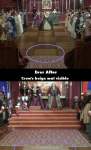
Trivia: After Rodmilla and her daughters leave for the masque, during the next scene at the royal palace a large sculpture can be seen in the courtyard, especially in some closeups from different angles, such as when Gustave approaches Leonardo. This mythologically themed sculpture consists of a tailed figure riding upon one of two creatures holding their reins, with a ship behind them. This sculpture can be seen during the very first scene, albeit with a few changes. When Wilhelm and Jacob Grimm walk into the Grande Dame's chamber she is sitting up in an unusual type of bed. Note the bed's "headboard" and "footboard" are the ship hull (in the fullscreen version the bed's side is visible with its distinctive design), and we also see the creatures (minus their horns) with the rider's arm holding their reins at the foot of the bed. Something else to notice near the end, when Leonardo gifts the young couple the belated wedding present the room they're all in is not in the royal palace, they are in the manor, gathered in the dining room where Marguerite had burned Danielle's book Utopia.


Answer: She's listed as Grande Dame in the credits and is addressed as "Your Majesty" by her servant and by Jacob Grimm. Many believe the Grande Dame may be the fictionalized version of the real Marie Therese of France, a descendant of Henry II. It's in the last scene, when the carriage is leaving with the Grimm brothers, that we see in the overhead shot the Grande Dame's chateau is the very same royal palace where Prince Henry had resided. During the first scene, as Jacob and Wilhelm Grimm enter the Grande Dame's chamber, when the camera pans slowly from right to left we see a man (behind the candles) who has been leaning over the Grande Dame at her right side, then a servant leans over at her left side announcing, "The Brothers Grimm," and just as she greets the brothers the two women dressed in black are standing nearby, one of whom is weepy. At the start of the next shot we see a man exiting in the background, and he may be the same man who had been leaning over the Grande Dame in the previous shot, so perhaps he is her doctor. After they've had tea, offscreen, we see the Grande Dame is sitting up in bed, and there are apothecary bottles on the bedside table. She herself is not dressed in black, she's wearing white/grey ruffled lace, with only one piece of black lace over her white lace cap. I don't get the impression she's in mourning; it seems reasonable to infer that the Grande Dame is ill. This is strong motivation for her to have written to the Brothers Grimm. Her desire to tell the truth of her great-great Grandparents' romance and life, so she could set the record straight about her great-great grandmother, before she herself is gone.
Super Grover ★