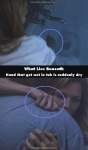
Continuity mistake: When Claire first sees the ghost, Norman rushes in and Claire grabs and hugs him. Her hand was just in the tub yet as she's hugging Norman, her hand is dry. She would have left some kind of a wet mark on Norman's shirt.
Directed by: Robert Zemeckis
Starring: Harrison Ford, Michelle Pfeiffer, James Remar, Miranda Otto, Amber Valletta, Joe Morton, Diana Scarwid, Katharine Towne
The ghost is that of Harrison Ford's student whom he had an affair with. When his wife (Michelle P.) finds out, he tries to kill her by drowning her in a lake. The ghosts comes and traps Harrison Ford under the water drowning him and lets Michelle P. escape. She visits the girl's grave and the movie ends.


Continuity mistake: When Claire first sees the ghost, Norman rushes in and Claire grabs and hugs him. Her hand was just in the tub yet as she's hugging Norman, her hand is dry. She would have left some kind of a wet mark on Norman's shirt.
Claire Spencer: That girl must be brought up.
Trivia: Right at the end, in fact the very last frame, you can see a face in the snow as the shot fades out.
Question: When Norman says the guy "that wrote that book he loves" (Shumway?) congratulated him on Spencer's Theorem, then Claire says "He didn't know your father was dead?" and Norman says "He knew". What does one thing have to do with the other? I've seen this movie at least 20 times and I can't figure out this conversation.
Chosen answer: Spencer's theorem was Norman's father's theorem. Norman wants to be greater than his father was, so to be accidentally complemented on something that his father did would be bad enough. To say that the guy knows that his father is dead is to imply that the guy probably insulted him intentionally.
Myridon