Revealing mistake: When MacReady burns the one "Thing" with the split head, in one shot it walks by MacReady in the foreground, and you can tell in that shot that it is just a still dummy burning, as it isn't moving at all. It just sort of floats past with its arms at its sides, while in the previous and next shots it is wildly moving around, arms flailing.
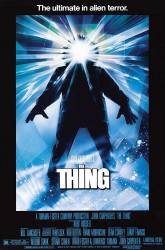
The Thing (1982)
1 revealing mistake - chronological order
Directed by: John Carpenter
Starring: Kurt Russell, Keith David, Wilford Brimley, David Clennon, T.K. Carter


Character mistake: When MacReady is giving the blood test, the scalpel they are using is not properly sterilized after each person cuts themselves (shown when Nauls cuts himself, then when Windows goes next: all he does is wipe the scalpel on his pants). Using the same scalpel seems like an extremely stupid thing to do as Fuchs told MacReady that even a small particle of the Thing could take over a person. (01:19:55)
Clark: I dunno what the hell's in there, but it's weird and pissed off, whatever it is.
Trivia: In the scene after Macready visits the Norwegian base, he is explaining what he saw to everyone. Childs questions what he says calling it voodoo, while Palmer says "Chariots of the Gods, man. They practically taught the Mayans everything they knew." This is in reference to Eric Von Daniken's 1968 book Chariot of the Gods, about ancient aliens being the catalyst for our modern world. (00:39:30 - 00:40:30)
Question: Why did Kurt Russell sound the alarm when the thing was attacking the dogs? He was nowhere near the area and could not see what was going on. Also before he pulled the alarm, the sound he would hear was too faint to think something was wrong.
Chosen answer: He sensed something was wrong and wanted as much help from the others as possible.
Answer: Having investigated the Norwegian camp, he could have conceived that the use of fire would be helpful. As such, he would need fire extinguishers after combating whatever the thing might be with the flamethrowers. It could have been foresight on his part that by ringing the fire alarms, somebody was more likely to bring fire extinguishers with them, thus allowing better control of the fire.
Answer: Remember that he'd just spent the whole day investigating how something mysterious and horrible destroyed the Norwegian camp, so he's already in a spooked state of mind. Hearing the dogs screaming at night is already unusual on its own, and also reminds him how this whole episode all started with a crazed Norwegian trying to kill a dog. Deep down he knows whatever happened to the Norwegians is now starting at their own camp.
TonyPH
I 100% agree.