Factual error: When Shawn has first infiltrated the college philosophy class, the professor begins to resume the class' previous lesson on what he calls "Buridan's paradox," relating a dog caught equidistant between two bowls of food. This paradox in real life is known as "Buridan's ass," and as the name would suggest, concerns a donkey. While the name was probably changed to sound more family friendly, a college philosophy professor would certainly know the proper name and details of said paradox.
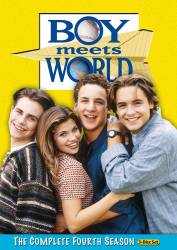
Boy Meets World (1993)
1 factual error in Fraternity Row
Starring: William Daniels, Rider Strong, Ben Savage, Betsy Randle


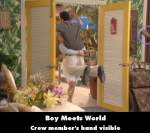
Visible crew/equipment: When Topanga carries Cory into the room you can see a crew member's hand triggering the doors to open.
More quotes from Boy Meets World
A Long Walk To Pittsburgh (2) - S4-E17
Trivia: Topanga is talking to Cory and she says, "My Aunt Prudence wouldn't even know who Romeo and Juliet are!" When her Aunt Prudence knocks on the door, she is played by actress Olivia Hussey, who played Juliet, in the 1968 film Romeo and Juliet, also starring Leonard Whiting as Romeo.
Janitor Dad - S4-E6
Question: When Chet and Verna are arguing about Chet getting a job, visible in the background is a painting of what I believe is an oak tree on a yellow background. Does anybody know the name and/or artist of this painting? My Grandparents used have a painting similar to it (if not the same one) and it also looks very similar to (and possibly the inspiration for) the cover art for the debut album of the band Days of the New.
Answer: I learned the answer to this one today. It is "Tree of Life" by Garé Barks.
Phaneron ★