Plot hole: The opera house is directly above the Phantom's hideout in the sewers, with an orchestra booming loudly overhead almost every night (the Phantom plainly hears the orchestra), but this constant vibration doesn't affect the integrity of the subterranean structure. But at the end, the noise of two simple gunshots causes the Phantom's hideout and a massive part of the sewer system to collapse.
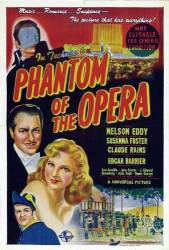
Phantom of the Opera (1943)
2 plot holes
Directed by: Arthur Lubin
Starring: Claude Rains, Edgar Barrier, Nelson Eddy, Susanna Foster


Plot hole: The opera house is directly above the Phantom's hideout in the sewers, with an orchestra booming loudly overhead almost every night (the Phantom plainly hears the orchestra), but this constant vibration doesn't affect the integrity of the subterranean structure. But at the end, the noise of two simple gunshots causes the Phantom's hideout and a massive part of the sewer system to collapse.
Trivia: When Claudin thinks his concerto has been stolen, he goes into a frenzy and attacks the music publisher. The publisher's assistant, Georgette, stops the attack by splashing a tray full of powerful etching acid into Claudin's face. Oddly, Claudin does not recoil when she throws the acid; rather, he leans forward, as if to ensure that it the liquid strikes him full in the face. Which is precisely what happened. To avoid having to shoot the messy scene more than once, we see actor Claude Rains deliberately leaning into the splash for a thorough dousing.
Question: Did Claude Rains really play the piano here?
Answer: No, Claude Rains was not a trained musician. He was coached on how to play the violin and piano, but Rains' playing was dubbed over in post-production.
raywest ★