Revealing mistake: In one scene just before the attack on a big Hunter the young captain (Jürgen Prochnow) is sitting with his charts. Beside him he has got a glass of beer standing. The sub lurches heavily right and left in the hard weather, but the surface of the liquid stays the same.
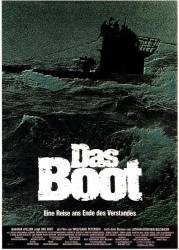
Das Boot (1981)
Plot summary
Directed by: Wolfgang Petersen
Starring: Jurgen Prochnow, Herbert Gronemeyer, Hubertus Bengsch, Klaus Wennemann
La Rochelle, (occupied) France, in late 1941: The adventurous, naive German war correspondent Leutenant Werner volunteers to go aboard U-96 and experience life as a crew member on a German U-boat hunting allied convoys in the North Atlantic. Little does he know the "adventure" is going to be a nightmare trip: After sinking three cargo ships, the U-boat is relentlessly hunted down by enemy destroyers, dropping endless rounds of depth charge and making the U-boat crew go through hell. Escaping narrowly, U-96 (already on its way back home) is re-assigned to sneak through the heavily guarded Straits of Gibraltar, virtually a suicide mission. The U-boat is discovered, attacked and sent to the bottom of the Straits. However, unbeknownst to the enemy, the crew manages to survive and repair the vessel underwater. U-96 resurfaces and finally makes it home. Having just arrived, however, allied fighters air-raid the port. Half of the crew gets killed (Werner among the survivors) and the boat is sunk in the dock - this time for good.


More mistakes in Das Boot
Captain: I'm sorry.
Lt. Werner: Is it hopeless?
Captain: It's been 15 hours. He's not going to pull it off. I'm sorry.
Lt. Werner: I asked for it. 'To be heading into the inexorable... where no mother will care for us... no woman crosses our path... where only reality reigns... with cruelty and grandeur.' I was drunk with those words. Well, this is reality.
Trivia: The full sized mock up of the U boat was rented by Steven Spielberg for use in the first Indiana Jone's film.
Question: What's the music the German band are playing at the end when U96 returns to port?
Answer: It's the 'Erzherzog Albrecht Marsch', composed 1887.