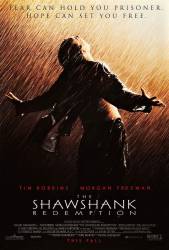
Factual error: Towards the end of the movie when Andy is escaping, he breaks open a sewage pipe and is covered with its contents. It is physically impossible for the sewage to shoot out of the break like it did. In order for that to happen there has to be pressure. But there is none there, because the end he crawls through is empty and the end is in the open air. (01:52:20)
Factual error: When Red is sitting under the oak tree in 1967 and pulls the money out of the envelope, the top bill is signed by Nicholas F. Brady, who was Secretary of the Treasury September 1988 - January 1993. It's less about reading the handwriting as noting the different appearance of different signatures from different eras. (02:14:40)
Factual error: In the scene where Andy first goes to work with Brooks in the library, the year is 1949 or 1950. Brooks tells Andy where the Louis L'Amour books are located. Louis L'Amour wasn't published in the US until 1951, and only had one book released before then.
Factual error: When the warden offers Tommy a Marlboro, the pack has Marlboro Miles on the side. That was a promotion that started in the 90s, and wouldn't have been on a pack in the 60s. (01:30:00)
Factual error: At the end of the film following Andy's escape from Shawshank there is a scene of him driving along the cliff edge in a red car. This car is a red Pontiac GTO from 1969. The year in the film is 1966, 3 years before the car was made. Confirmed in commentary. (01:57:45)
Factual error: In the scene where Red is working in the Food-Way shortly after his release in 1967, there are cartons of "More" and "Newport" brand cigarettes visible on the shelf to his right. "More" was not released until 1975. (02:09:25)
Factual error: In the library, Heywood is listening to Hank Williams' "Lovesick Blues." He is playing the double LP "Hank Williams 24 Greatest Hits," which was originally released by MGM in 1970. "Lovesick Blues" was recorded long before this, but it is not possible for him to have acquired that particular 1970 double LP.
Factual error: Chess is played with a white square at the right end of the first row. You see the chess board with the stone figures in Andy's cell, and every time there is a black square on the right. Andy would have known better.
Factual error: In the courtroom scene there is a microphone - a 1955 Shure SM55. The courtroom scene was set in 1947.
Factual error: In the scene where the guys are drinking beer on the roof, the bottles have "ribbed" tops. Beer bottles did not have twist-off's in the late 40's.
Factual error: Red, while using the restroom in the grocery store he worked in after getting out of jail, is peeing in a 1980s urinal.
Factual error: When Red is working in the grocery store after his parole, as a bagger, the cashier is using a National C100 register, which is a non-itemizing register. This wouldn't be usable at a checkout in a grocery store, as the customers usually have multiple items.
Factual error: The sign for Buxton is horizontal with two poles. Signs for Maine towns are vertical and mounted on a single post.


Chosen answer: In the original novella it is revealed that Andy smuggled $500 into the prison inside of his rectum. During an interview in 2004 Robbins incorrectly quoted the amount as being $100. The narration up until Red's release is provided as Red writes his account of the events while still in prison, and employs the same method to smuggle the story out. But since the issue of Andy smuggling in $500 into the prison isn't addressed in the movie, we should assume that he smuggled it in. In addition to this, the wardens scams are described as "near slave labor." From this we can assume that it is possible the inmates are getting paid (an incredibly small) wage. Perhaps Andy, with his financial knowledge, knows how to haggle, barter and stretch a dollar. One last (but not as likely) scenario is that Red allows some sort of lay by system to inmates.