
Factual error: The accident takes place the night of July 18, 1969, and they show there being a full moon. That night the moon was actually waxing crescent with only 14% visible, and set at 10:27pm while the accident happened about 12:45am, so there was no moon in the sky anyway.
Factual error: The vehicles in the convoy are supposed to be armored since the bullet fired by 50 BMG was absorbed into the glass. First off the vehicles are standard, not up armored since the windows are standard factory and not thick ones used in up-armored cars. The highest rated armored car is B7 which will stop armor piercing not 50 BMG. Also, the windows completely shatter after being shot out; armored windows will never shatter, they stick together and chip off. (00:03:00 - 00:05:00)
Factual error: When the saturation divers open the outer hatch on Kursk, they drop a glow stick. When they do, it falls to the floor on the submarine, indicating the inner hatch was open. The inner hatch of Kursk was closed, later opened by an ROV.
Factual error: The bunkers which are visible in the movie have not been prepped to look how they should in the years after the war. They would have been plastered and painted, not looking old and rusty as they appear in the movie.
Factual error: The film states that the story takes place in the year 1998. Everything in the opening scenes crams in every 90's cliché imaginable to reinforce the era. However, at 1m56s into the movie, the main character is driving on the freeway and it cuts to a shot showing that he's driving behind a marked police car. Specifically, a Police Interceptor model Ford Explorer that did not hit the market until 2012. (00:01:56)

Factual error: At the end of the film, Hellfire Jack returns the toy soldier to the son of the late William Hawkins in 1917. Hawkins son is shown taking it upstairs and placing it in front of a photo of his father, in between two medals. These are the British War and Victory Medals - these did not exist until 1919, and in most cases were not even issued until the 1920's.

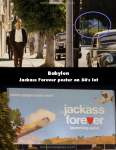
Factual error: At the end of the film a character is walking through a studio lot in 1952. Through the trees behind him can be seen a section of a poster advertising Jackass Forever (2022).
Factual error: Henk arrives in Moscow. The KGB gets a copy of his passport. In the next scene, a building can be seen, and a Trabant 601 drives through the shot (one light out). Trabant was East German made and widely exported on the Eastern Block but never to the Soviet Union. This car is definitely wrong there. (00:30:40)
Factual error: Early in the film, as the train pulls into the station, you can see 2 European Traffic Control Systems. A signalling system that was only installed in 2010.

Factual error: Sassoon's Military Cross medal is shown ending up thrown in the Mersey and sinking. In his own words from "Memoirs of an Infantry Officer", published in 1930 - "I ripped the MC ribbon off my tunic and threw it into the mouth of the Mersey. Weighted with significance though this action was, it would have felt more conclusive had the ribbons been heavier. As it was, the poor little thing fell weakly on the water and floated away as though aware of its own futility."

Factual error: Someone shouts "jobsworth" at a London Underground official. This term is first recorded in 1970. The film is set in 1940.

Factual error: Although addressed throughout the film using his correct rank of Obersturmbannführer (Lieutenant-Colonel), Rudolf Höss wears the rank insignia of the lower rank of Sturmbannführer (Major).

Factual error: The Six Triple Eight depicted has officers and privates but no NCOs whatsoever. In reality, the battalion had the same complement of corporals and sergeants as any other battalion.

Factual error: The BBC announcer says it has been almost thirty years since the coronation. Since the film is set in 1970 and the coronation was in 1953, this is completely incorrect. Not a mistake the BBC is likely to have made.