Factual error: Gary Sinise looks at a computer screen with a short section (about two full twists) of DNA on it and proclaims that "This DNA looks human." He could have been looking at DNA from any single-celled organism and it would have looked just as human as what he was looking at. All mammals have 90+ percent of their DNA in common, he would have to have sequenced the entire DNA strand (something like 3 billion pairs of nucleotides) to identify it as human, something that would be totally beyond the capacity of anything but a well-equipped genetics lab, something they show no sign of having.
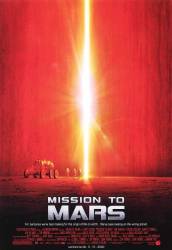
Mission to Mars (2000)
Directed by: Brian De Palma
Starring: Don Cheadle, Tim Robbins, Gary Sinise, Jerry O'Connell, Connie Nielsen, Kim Delaney
Factual error: The crew of the rescue mission abandon ship after the engines explode. They then rendezvous with a supply module that's already been in Martian orbit. The problem is that the engines exploded just as they were attempting an orbital transfer a from solar orbit to a Martian orbit. As they were unable to make the necessary burns to slow down and correct their angle to complete the transfer, they wouldn't stay in the vicinity of Mars for very long at all.
Factual error: Their complete and utter disregard for the most basic scientific facts in this movie is amazing. It's already been said that Gary Sinise couldn't possibly have recognised the DNA sequence as human (that segment may have been enough to produce a single protein common to any lifeform). The thing that gets me is that he recognises that the DNA is missing a couple of "chromosomes" to complete it. DNA is made of units called nucleotides (remember A,T,C,& G?); chromosomes are formed by huge strings of DNA wound together (not the other way around). You don't need a degree in Biology to know this, you just need to have stayed awake in high school.
Jim McConnell: They're us. We're them.
Jim McConnell: There's pressure in here.
Terri Fisher: Above Mars atmospheric? That's impossible.
Jim McConnell: We're millions of miles from Earth inside a giant white face. What's impossible?
Terri Fisher: The genetic difference between men and apes is only three percent. But that three percent gave us Einstein, Mozart.
Phil Ohlmyer: ...Jack The Ripper.


Answer: There was no actual blood or graphic display.
No graphic display? A man is shown on camera being violently torn to several pieces by high G-forces, and there was indeed blood visible. There's also a scene later in the movie where shrapnel completely pierces the palm of a man's hand, complete with a zero-gravity blood spurt.
Phaneron ★
I remember watching it for the first time thinking it was a pretty graphic death scene for a PG rated film, but I think it's a stretch to say it was verging on R rated. There isn't that much blood, the guy is in a space suit, and it happens very fast. Studios can lobby the MPAA for what rating they feel the film deserves, and it is likely Disney argued for a lower rating than PG-13, and the MPAA agreed.
BaconIsMyBFF
Well, by "verging on R-rated," I meant that even in a PG-13 film, that scene would have been pushing the envelope. I would imagine there were a lot of parents at the time who took their young children to see the new Disney film about going to Mars and were not pleased with that scene.
Phaneron ★
A PG rating does not mean family friendly. A "Parental Guidance" rating warns there may be strong language, sexual content, violence, or graphic images. No one should expect a G-rated Disney film. I watched the "twister" clip on YouTube and wouldn't say it's gruesome. It's not a close-up shot of the rapidly spinning body being pulled apart; it's rather blurred, and there wasn't much blood. I realise it's a matter of opinion regarding what is considered too violent.
raywest ★
Yes, but you're also an adult, and you watched the clip having an idea of what you were about to see. If you read the comments on that clip, you'll see a lot of people saying that scene traumatized them as children. Violence like that from earlier PG films is why the PG-13 rating was later invented, and it just struck me as odd that that was able to get a PG rating in the year 2000.
Phaneron ★
My point is that parents were (or should have been) aware of the PG rating before taking their children to see it and that it might be unsuitable for younger audiences. It falls upon them to make sure they do not take their children to a film that could contain disturbing scenes. By 2000, movie violence had become far more graphic and mainstream.
raywest ★