Plot hole: Being transported from the west of Costa Rica all the way to Northern California by ship would take about a week. Are we to assume that Owen, Claire and Franklin were staying put in the back of the truck the whole time undetected? They would have to eat and use the restroom, at least.
Jurassic World: Fallen Kingdom (2018)
Directed by: J.A. Bayona
Starring: Jeff Goldblum, Chris Pratt, Bryce Dallas Howard, Ted Levine
Upvote valid corrections to help move entries into the corrections section.
Suggested correction: Maybe they did have to sneak around but the director thought making us watch Owen sneaking away at night to take a whiz wasn't really important to the plot.
It was established in the plot's timeline that the ship travelled overnight. A ship like this travels at about 12 knots and would take for them about 9 days to complete that voyage.
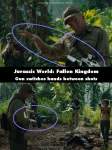
Continuity mistake: When Ken Wheatley is pointing his tranquilizer gun at Zia after he shot Owen, he puts the gun in his left hand and uses his right hand to wave his men down, but mid wave, the camera cuts to a different angle and he is waving with his left hand while holding the gun in his right hand. (00:30:00)
Plot hole: There was only one T-Rex on the island. When Owen and the others are running down the side of the island escaping the volcanic ash, another dino tries to eat them but then the T-Rex shows up and kills it. This establishes the T-Rex was there in that spot. Owen and the others then wash up back on shore and find the soldiers loading the dinos on a boat and stow away. Then when Blue is bleeding out they have to get a blood transfusion and the only viable candidate is the T-Rex who is now captured and sedated on the ship. How did the soldiers capture, let alone bring the Rex to the ship from where it was seen by Owen back up over hills and rocky terrain? It would have been an all day process just to haul the T-Rex to the ship. It just magically appears on the ship after they stow away on it and can provide the blood Blue needs.
Upvote valid corrections to help move entries into the corrections section.
Suggested correction: There was a shot showing the T-rex being carried to the boat via helicopter during the beach scene before the transfusion occurs.
Trivia: The way that the Indoraptor portrays itself behind the window and touches the floor with its claw in Maisie's room is a nod to the original Jurassic Park. (01:44:10)
More trivia for Jurassic World: Fallen Kingdom
Owen Grady: Nervous flyer?
Franklin Webb: Would you ride a-a thousand pound horse that's been abused all its life?
Owen Grady: I rode my motorcycle through the jungle with a pack of raptors.
Franklin Webb: We're not compatible. (00:21:50)
Ian Malcolm: Welcome... to Jurassic World.
Claire Dearing: Be careful, okay?
Owen Grady: If I don't make it back, remember... you're the one who made me come. I'll be all right. (00:30:40)
Question: Would any company in their right mind build a theme park (or any business for that matter) on a private island with a volcano? I know populated areas like Hawaii just assume the risk, but wouldn't a company that has the money to purchase their own island do their due diligence and make sure they won't be prone to a major catastrophe like that?
Answer: As it was stated in the film, the volcano had been dormant for many many years. Presumably even since well before the events of the first Jurassic Park movie in the early 90's. It was only recently, between the events of this film and the prior Jurassic World that the volcano had its surprise re-awakening.
For sure, but dormant simply means that the volcano could one day erupt again, so wouldn't it be pretty foolish to gamble on building a multi-billion dollar theme park with the hope that the volcano will never again erupt?
One would think. But just look at our world's history. Like Pompeii, an entire civilization wiped out cause they lived at the base of a dormant volcano. And then even in more recent history. Mount Saint Helens, which I've actually been to and seen the exhibits and footage of it's destruction. Foolish, yeah. But that doesn't stop us from still doing it repeatedly.
I think it's been made pretty clear over the course of all the films that the people building these parks did not exactly think everything through properly. They took a gamble on the volcano, and they lost.
Question: How exactly did Zia become a paleoveterinarian if she had never even seen a dinosaur beforehand? Wouldn't she need some practical experience on a living subject?
Answer: Would add to the other answer that while "paleo-veterinarian" is not a formally recognized degree or specialization in veterinary medicine, it is a field of study and practice that involves applying veterinary knowledge to the study of extinct animals, especially dinosaurs. This includes understanding and theorizing how their anatomy, physiology, and diseases might have been, and applying this knowledge to modern animals. Though Zia apparently had no hands-on experience with living dinosaurs, she would have studied fossils and also birds and reptiles that had some relationship to extinct dinosaurs. She may also have had some access to InGen's scientific research, read their scientific publications, etc.
Answer: I think you could make a compelling argument that paleoveterinarians are probably held to a different standard than normal veterinarians because it's an extremely niche study. Being a paleoveterinarian is wildly specific, and having the chance for practical hands-on experience with dinosaurs would be rare and difficult to the point of being borderline impossible. Dinosaurs are only in a few specific locations, and there have been repeated incidents basically necessitating that people keep away outside of very rare exceptions. But you can't just not have them, so getting licensed is probably based more on study than experience.
More questions & answers from Jurassic World: Fallen Kingdom


