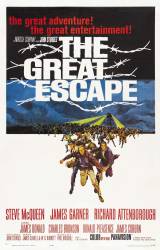
The Great Escape

Character mistake: When Werner asks Hendley why, as an American, he fights alongside Britain, he mentions that the British burned down the U.S. capital in 1812. While it happened during the War of 1812, the burning of Washington actually occurred in 1814. (00:11:10)

Cubs Fan

Upvote valid corrections to help move entries into the corrections section.

Suggested correction: The question was intended to demonstrate how far out-of-touch Werner was with United States history.

Charles Austin Miller

You misunderstand. Werner's question in and of itself is not the mistake; it's merely a point of contextual reference. The mistake is him giving the incorrect date of a historical event he claims to have read about; it's hard to believe that every book that he might have read on the topic are all wrong, so he must be remembering, and thus repeating it, incorrectly.

Cubs Fan

Character mistake: When Werner goes to see Hedley for helping finding his "lost" papers, Hedley is playing chess. The chess set is set up incorrectly. When the men are set up properly, each player has a light colored square in the right-hand corner. In the movie, the game is set up so that the light-colored square is in each player's left-hand corner. This "beginner" mistake puts the king and queen in the wrong positions.

Character mistake: When Sedgwick is bringing the cement tunnel lid to Willy, somebody yells out "Hey Hendley" and Sedgwick answers "Hello boys". He was called by the wrong name.

Factual error: Why is Hilts not wearing a uniform? A serving officer captured behind enemy lines in civilian clothing risked being shot as a spy. If a prisoner's uniform was too worn or damaged to wear, it was routine for the German authorities to replace it - a P.O.W. in civilian clothes is an obvious escape risk. He is wearing a pair of tan chinos, a cut off sloppy Joe sweatshirt, both ridiculously anachronistic - Sixties hipster fashions - and nowhere even close to a World War 2 uniform. He is also wearing Army Type III Service boots - something that would never have been issued to a fighter pilot.

Upvote valid corrections to help move entries into the corrections section.

Suggested correction: Hilts was a POW for a few years before being transferred to this camp. His current clothing likely changed from when he was originally captured in his uniform, so he would not have been considered a spy. After multiple escape attempts, his uniform could have been ruined. The Geneva Convention required that POWs receive shelter, food, clothing, medical care, etc. The Red Cross delivered care packages to POW camps containing food, miscellaneous apparel, and other essentials. Sweatshirts have existed since the 1920s and changed little. Also, chino pants have been around since the late 19th century. Hilts was an U.S. Air Force pilot, and light-colored khaki trousers (similar to chinos) were standard-issue uniform for some U.S. military branches, along with leather bomber jackets for Air Force pilots. Therefore, he is dressed appropriately for his military branch.

raywest

And none of them would have been available to a prisoner in a German POW camp in the mid 1940s. Not one single item of hipster fashion would have found its way into the camp. Even if it did, do you really think the German authorities would allow a prisoner to lounge about in civilian clothing? Talk about an escape risk.

The camp was in Germany, not Poland. As I previously mentioned, other than the sweatshirt, Hilts appears to wear military clothing - a leather pilot's bomber's jacket with military sleeve insignia, and U.S. Air Force khaki trousers. So not "hipster" '60s civilian clothing. The sweatshirt could be military appropriate (even issued) and something Hilts acquired at a different camp. He arrived with a small duffel bag that presumably had some misc clothing. He and two other POWs are the only Americans and have different uniforms. The current camp commandant, who apparently disdained Hitler and his Nazi minions, would decide what POWs could wear.

raywest

More mistakes in The Great Escape

Colonel Von Luger: Are all American officers so ill-mannered?
Hilts: Yeah, about ninety-nine percent.

More quotes from The Great Escape

Trivia: Paul Brickhill, who wrote the novel the film is based on, was a member of the X organization which planned the escape.

More trivia for The Great Escape

Question: At the scene where Bartlett is running away from the pursuing Germans in the town, a car stops him. Bartlett says something in a foreign language to the German who steps out the car which makes the Germans drive away. Could someone please tell me what is said in the Bartlett/German conversation and what language does Bartlett speak in.

Answer: It's German, although I can't quite make it all out. The Germans tell him to stop (sounds like one says "hey you" in English). He asks what this is all about and, in English, the soldier accuses him of being English. Bartlett acts offended at the idea, and at being threatened with a pistol. The soldier then asks if he's German, he says something in the affirmative, and the soldiers apologize as they climb back in the car.

It sounds like the last line from the German Officer is" Free to Go" in English.

Answer: I am German and just watched the movie. From memory the conversation went something like this: German guard talks in English and Bartlett responded in German "English? What are you thinking?" German guard: "Oh so you're German?" Bartlett: "Yes why! Of course I am German. What is the meaning of this? Threatening me with this pistol?" German guard: "Well all right then." And they leave him alone. Although his accent would have given him away, it's a lot less strong than most English people's German, but still noticeable.

More questions & answers from The Great Escape