Other mistake: The movie starts with scenes from a battle between Romans and Sarmatians. For a few seconds, we see a (very dark) shot of a warrior holding a severed head in his hand. That very same shot is used later in the battle between the Woads and the Sarmatian knights protecting the Bishop. Director's cut only. (00:01:05 - 00:08:30)
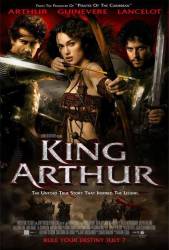
King Arthur (2004)
1 other mistake - chronological order
Directed by: Antoine Fuqua
Starring: Keira Knightley, Joel Edgerton, Ray Winstone, Ioan Gruffudd, Stellan Skarsgard, Clive Owen, Stephen Dillane


Factual error: I normally wouldn't bother with this sort of nitpicking, but this film specifically claims to be historically researched - and it's full of historical blunders. For a start, the film is set as the Empire withdraws its last troops from Britain - which was in 407 AD. Now Artorius Castus was a real Roman officer who really did command Sarmatian foederati at Hadrian's Wall, but he died around 200 AD. Cerdic was a real Saxon warlord who did go raiding the Britons with his son Cynric, but he did this in the early 500s. Pelagius really was tried for heresy, but he was acquitted and died of old age; the trial was a decade after this setting, and in the fifth century you couldn't be executed for heresy anyway. Also in the fifth century the Pope had no authority over Imperial troops. I could go on and on but that will do for now.
Cerdic: You come to beg a truce, you should be on your knees.
Arthur: I came to see your face so that I alone may find you on the battlefield. And it will be good of you to mark my face, Saxon, for the next time you see it, it will be the last thing you see on this earth.
Cerdic: Ahhh. Finally, a man worth killing.
Trivia: The part that the film's sword master (Mark Ryan) played in Robin of Sherwood was called Nasir. He had dark curly hair, a well-groomed beard, wore black leather and fought with two swords that he wore on his back in a specially designed sword belt. Lancelot looks very like him in this movie - have a look at this link: http://www.blackplanet0.freeserve.co.uk/robinpics.htm.
Question: What does the Saxon who rallies the troops actually yell? He yells it twice: once, after Cerdic meets with Arthur in front of the wall and gives the order to "prepare the men for battle", and then a second time when Cerdic gives the signal after the only survivor of the first "wave" comes back through the wall. (And I don't mean his cry of "battle formation.").
Answer: He yells 'Schlachtet den feind!' (In very, very bad "German") - 'slaughter the enemy!'. And his army seems to yell: "Schlachtung! Schlachtung! Schlachtung..." - "Slaughter! Slaughter! Slaughter..."
Answer: I don't think it's supposed to be German. Probably Old Saxon. Could be something like "slahten fiand" - slaughter enemy.