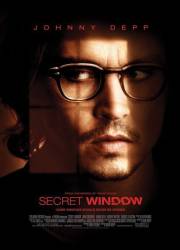
Secret Window
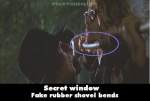
Secret Window mistake picture

Revealing mistake: When Shooter pins Mort against the tree with the shovel, you can see that it's a rubber shovel because it's bending around Mort's neck. [Mentioned on commentary]. (00:40:45)

BillyBlake

Revealing mistake: When Mort stops at the gas station to talk to Ted, and he gets out of his Jeep, the key is still in the ignition but there's no dinging from the door being opened (which we know it does from an earlier scene).

MovieFan612

Continuity mistake: When Mort is in Ken's office telling him about John harassing him. Ken punches the right side of the chess clock down to start it. Then Mort punches the left side, his right to stop it. Then when the camera switches back to Mort's point of view the the left side is up and the right side is down, then Ken punches down the left side to start it, when the right side should have been the one he had to press down to start it.

pross79

More mistakes in Secret Window

Mort: I don't care. I'm just gonna smoke. I'm just gonna totally smoke. I'll finish these, go to the store and get a brand-new pack, smoke the shit out of that one.

More quotes from Secret Window

Trivia: One should really stay to the very end of the credits, as Johnny Depp (Mort) sings an amusing little tune.

More trivia for Secret Window

Question: What is the meaning behind the Morton salt and other groceries that Mort buys at the end of the movie?

Answer: Mort Rainey buys the salt, butter, and napkins for eating the corn he grew in the garden above Ted and Amy's graves. The "Morton" brand of salt uses the advertising slogan, "when it rains, it pours." Mort Rainey's name can be translated to "raining death." The "Vanity Fair" napkins could be a refernce to Mort's personality.

raywest

The term Vanity Fair was coined (I believe first) by John Bunyan in 1678, as a place in a story called ‘The Pilgrim's Progress'. Mort is referred to as ‘Pilgrim' by a few different characters in the film, including himself, without much explanation until the serviettes. Brilliant. Vanity Fair in John Bunyan's story is a never-ending fair of frivolity, which is similar to Mort's charade of denial. Found this info when I searched the meaning of Vanity Fair on vocabulary.com.

Bunyan's The Pilgrim's Progress was also the inspiration for William Thackeray's 1847 novel, "Vanity Fair."

raywest

More questions & answers from Secret Window