Corrected entry: When the dimitridon (those sail-finned dinosaurs) is attacking the Count and the Professor, the Professor states that dinosaurs can't swim. Then why would a whole pack of them live on the seashore? If they can't swim, than what's the advantage? They wouldn't be able to catch fish, and crabs would be too small.
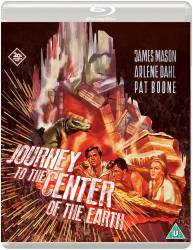
Journey to the Center of the Earth (1959)
1 corrected entry
Directed by: Henry Levin
Starring: James Mason, Diane Baker, Pat Boone, Arlene Dahl, Alan Napier, Peter Ronson, Robert Adler, Thayer David


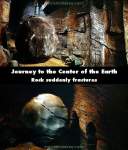
Revealing mistake: A boulder tumbles towards James Mason and his party though a cave. With all the smashing against the walls and floor of the cave, the boulder stays entirely intact. However, just before the boulder hits a wall with two tunnels while flying through the air, the boulder now shows two majors fractures that were unseen earlier. The fractures were added to the boulder to give it a more dramatic impact by it breaking up with one piece nearly striking James Mason. (00:55:50)
Sir Oliver Lindenbrook: A field of force that snatches gold away! This is it, this is it! The junction of magnetic forces from the North Pole to the South Pole - the center of the earth.
Trivia: A naggingly familiar quote that has been attributed on the Internet to various authors (ranging from Edgar Allen Poe to Henry Wadsworth Longfellow) is "Sleep. Those little slices of death. How I loathe them." Problem is, Poe never wrote any such thing, and neither did Longfellow. The 1987 horror film "Nightmare on Elm Street III" seems to be the genesis of the misquote, which it incorrectly attributes to Poe. So, where did the actual quote originate? The answer is Walter Reisch, lead screenwriter on the 1959 film "Journey to the Center of the Earth." In the screenplay, the antagonist Count Arne Saknussemm is urged to get some rest, to which he memorably replies, "I don't sleep. I hate those little slices of death."
Question: When the gang explore the ruins of the city, you can hear a low pitch humming noise. What was making that noise?
Correction: Crabs may be too small, but animals that prey on crabs may not be. Fish can also wash up on the beach, and they can scavenge them and larger fish or aquatic reptiles. Also, rivers and streams usually empty into the ocean, so fresh water would be nearby. If they also eat vegetation, there is probably an abundance of vegetation around a shore as well. They may also prefer the open terrain for its abundant sun.