Revealing mistake: At the beginning of the "Day 50" scene, there is a shot of the "human" meat thawing - in the top right of the screen, a pig snout is visible. (01:13:00)
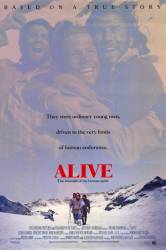
Alive (1993)
Plot summary
Directed by: Frank Marshall
Starring: Ethan Hawke, Josh Hamilton, Vincent Spano, Bruce Ramsay
A group of Uruguayan rugby players make an annual trip to Chile with friends and family. The pilots make a mistake and think that they have passed the Andes Mountains but they haven't. Rescue searches give up on them and they run out of food. They are then forced to eat the bodies of their friends that died. Finally, Nando and Roberto walk out of the Andes to seek rescue.


Upvote valid corrections to help move entries into the corrections section.
Suggested correction: There is no pig snout. That is the end of a sleeve that has meat in it for their trip.
Roberto Canessa: We're gonna die, you know.
Nando: Maybe. But if we die, we're gonna die walking.
Trivia: The guy who first follows Parrada and Canessa on their expedition to find Chile is nicknamed Tintin. In one of the most famous Tintin albums the cartoon hero goes to the Himalayas to find a friend who is reported dead after a plane crash in the mountains. Most likely a coincidence, but still notable.
Question: I'm curious as to why Paéz is the narrator in the beginning and end of the film, when the movie focuses mainly on Canessa and Parrada as main characters. Almost all of the boys are alive today, and even if they weren't it is not Páez himself who is being interviewed but John Malcovich as Páez. So I'm still curious as to why they chose Páez instead of Parrado or Canessa, as they are both alive today.
Answer: Keeping in mind that some parts of the audience were not familiar with the details of this story, using Paez as the narrator retains some of the suspense of Canessa and Parredo's journey across the Andes. If the audience is not told at the start that they survive, at least some viewers may have considered that one of them may die during their trek to civilization.