Revealing mistake: At the end when Norman is being stabbed at by Mary dressed up as Mother, Mary stabs Norman in the hand. You can plainly tell that this hand is a doll, as it is not a natural colour, it is stiff and is stationary, unlike Norman who is moving his hands. (01:35:10)
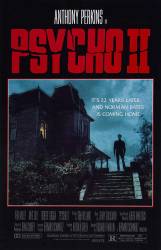
Psycho II (1983)
0 reviews
Directed by: Richard Franklin
Starring: Robert Loggia, Anthony Perkins, Vera Miles, Meg Tilly
Your rating
Average rating
(4 votes)


More mistakes in Psycho II
Norman Bates: Just, don't let them take me back to the institution.
Trivia: The reflection of young Norman Bates in the doorknob when he flashes back to his mother's poisoning is Anthony Perkins' son, Oz.
Chosen answer: The murderer is Emma Spool, Norman's biological mother. She was killing people because she didn't want anybody harming Norman.
Emma was not Norman's biological mother. She was the sister of Norma (and Norman's aunt) and jealous that Mr. Bates chose Norma over her and thought Norman should have been the son she and Mr. Bates were suppose to have. Later, while still mentally ill, she believed Norman was her son and told Norman this.
Bishop73
Emma Spool was, in fact, Norman's biological mother. It was revealed at the end of the movie that she is his real mother and Norma Bates is her sister who adopted Norman and raised him While Emma was institutionalized.
ctown28 ★
Again, that was just Emma being delusional and/or lying. Tracy Venable tells Norman the truth in Psycho III. Emma was never his mother.
Bishop73
I never knew Emma Spool was Norman's biological mother. In fact, I never heard of Emma Spool. Thanks.