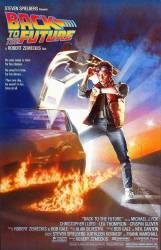
Continuity mistake: Towards the very end of the film when George and Lorraine are unpacking George's new book, you will notice in the close-up of Lorraine's hands that they are actually someone else's for that shot. They are very aged and much larger than her real hands, which you can compare right away when the camera goes back to full view. (01:49:25)
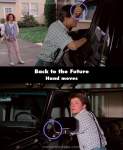
Continuity mistake: While Marty is admiring the new truck, Jennifer walks onscreen. Once the angle changes, Marty's left arm is resting on an entirely different part of the door. (01:49:50)
Continuity mistake: As Marty drives the DeLorean towards the clock tower, if you look carefully you can see that he drives past the 'Bluebird Motel' billboard at least 3 times (which is where he started from) and drives past that small building with the slanted grey roof in the square about 4 times.
Continuity mistake: Lorraine throws Joey's cake on the table and a close-up shows nothing next to the tray. When the angle changes, a Pepsi can has appeared right by the middle of it.
Continuity mistake: When Marty is playing at the dance the picture on the guitar disappears in some shots.
Continuity mistake: After Doc accidentally unplugs the cable and is sending Marty back, he unplugs the cable 15 seconds later and it shows Doc, and the clock's hand change. A split second later the clock's hand changes again.
Continuity mistake: While being chased by Biff, after Marty knocks down a man and a woman, the man stands up and helps the woman stand up, but a frame later he is rolling on the floor with the woman on top of him.
Other mistake: The first time-travel experiment involving Einstein the dog, he goes one minute into the future after the DeLorean excelled to 88 mph. Yet after the minute is up and Einstein returns, the car emerges already braking, and screeches straight to a halt. At 88 mph, it would have to travel much further even to quickly stop the car. Look at all other time-changing moments in the three films. The car takes much longer to stop.
Continuity mistake: When the wind unplugs the cable connected to the tower and Doc runs towards it, the position of the cable changes between one shot and the other in barely half a second.
Factual error: Video/audio output on the JVC camcorder (if it had any at all) would not be compatible with 1955 TV. if available the camcorder output would be composite, component or COAX - all would need some sort of adapter for the audio/video to work on the TV. COAX would be the simplest, but they would need to invent the 75 ohm to 300 ohm adapter.
Continuity mistake: When Marty is running through the car park you can see a person in the background in one of the shots but they disappear in the next shot, then re-appear again.
Continuity mistake: Just as Marty is going to be set back to 1985, the camera keeps showing shots of Marty, and the lightning poles coming closer and closer to him. Now Marty is supposed to be going 88MPH and mostly every shot just as the lightning is about to strike is basically the same distance from the lighting poles to the car.

Visible crew/equipment: Marty travels to 1955 for the first time and parks the DeLorean behind the Lyon Estates sign. He then stops a vehicle with an old man and woman who scream, "Don't stop or we'll die." On the lower left of this shot is the shadow of the camera (not visible in the standard widescreen version).
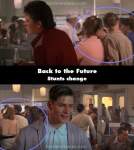
Continuity mistake: When Marty tells George how to flirt with Lorraine, they both enter the diner and Marty sits on the back of the counter but disappears between shots, only to reappear later on. Also, the extras around him change, although they're all dressed in similarly colored clothes. Check a man in a plaid jacket next to the blonde girl in pink, who disappears when Marty trips Biff. This continuity havoc was due to the combination of Eric Stoltz scenes and new Michael J. Fox reshoots.
Continuity mistake: At the very end of "Earth Angel", after kissing Lorraine, George waves to Marty on stage, who waves back and flexes his right hand, holding it up. It then switches to a wide shot for the end of the song, and Marty's right hand is down on the guitar again.
Continuity mistake: When Marty is holding on to the back of the truck, Biff attempts to hit him with his car. Marty quickly pulls himself to the side of the truck to avoid being hit but in the next shot, he is holding on to the back of the truck.
Continuity mistake: Before Marty kicks the speaker while playing Johnny B Goode, there is a case of Pepsi below it which disappears between shots.
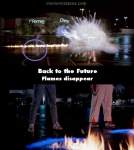
Continuity mistake: After the DeLorean disappears with the dog inside, flames appear underneath Marty and Doc. In the close-up of their legs, a shot later, the road is spotless and the flames reappear a second later.
Continuity mistake: When Marty is up on stage "disappearing" and yells "George..." (wanting for George to resume the dance with Lorraine and ultimately kiss her), this exact shot of Marty shows him slumping over and appearing very weak, almost on his knees. A split second later showing that same scene (right when George finally walks back to Lorraine) only from the "crowd view", Marty is still standing upright, not slumped, maintaining his composure.
Continuity mistake: In the scene at the beginning of the film where Marty cranks up his giant amplifier, the resulting explosion blows Marty into a shelf which tips over, spilling all of its contents on top of him. In the next shot, despite the shelf having been emptied in the previous shot, papers and file folders continue to fall on Marty.


Answer: The video camera was in the DeLorean. With the right kind of adapter, which was common enough in the 80s that Doc might've had it on the camera or been able to jury-rig something in the 50s, it would have been possible to connect it into the antenna screws in the back of the TV like an old Atari and play it directly from the camera.
Captain Defenestrator
TVs in the 50s had a two prong antennae connection (two screws in the back that you put a prong antennae into) TVs in the mid 80s also had this. The coax connection (the one wire that screws in) was starting to become common, but, the two prong connection would have been more likely on any given TV at the time, so, whatever wire they used to preview recordings probably had that. very convenient that Marty brought those cords with him.
An old Atari 2600 RF Adapter would be how one would link a video camera to an old-fashioned television. A simple-enough part that Doc could probably make one with 1950s technology.
Captain Defenestrator