Audio problem: During the scene with the astronauts building the makeshift CO2 scrubber, Jack and Fred are getting the tape ready and tearing it lengthwise. Capgo says, "Alright," indicating he was going to move to the next step. Fred responds, "Hold on, Houston." Bill Paxton's mouth does not move, and he is visible.
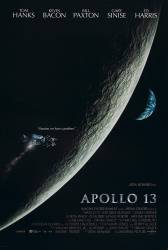
Apollo 13 (1995)
1 mistake since 11 Mar '25, 02:54
Directed by: Ron Howard
Starring: Tom Hanks, Ed Harris, Kevin Bacon, Bill Paxton, Gary Sinise


Gene Kranz: I don't care about what anything was *designed* to do. I care about what it *can* do.
Trivia: The exchange between Lovell and his wife about holidays ("you know that Easter vacation? There's been a change of destination ... how about the moon?") in fact took place in 1968, when Lovell was assigned to Apollo 8 and so missed his planned Christmas vacation.
More questions & answers from Apollo 13
Answer: Spacecraft re-enter Earth's atmosphere at extremely high velocity (thousands of miles per hour). Atmospheric friction slows the spacecraft descent somewhat; but, without parachutes, the Apollo spacecraft would still reach the surface traveling at hundreds of miles per hour. Landing in water at such high speed would be like hitting concrete, which would of course be instantly fatal. Hence the necessity of multiple parachutes. The Apollo program (and all early U.S. manned space programs) chose to land in the ocean for two reasons: 1) It was easier to track spacecraft re-entry from horizon-to-horizon at sea without visual and radar obstacles, and; 2) It was faster and easier to position several Navy vessels in the general splashdown location, then deploy helicopters to rapidly retrieve the astronauts and their spacecraft.
Charles Austin Miller