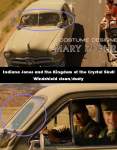
Continuity mistake: The military car racing against the young kids has its right windshield covered in dust, except for the wiper's track. A frame later the glass is clean.
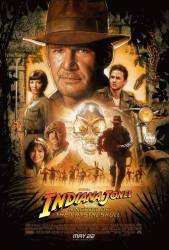
Directed by: Steven Spielberg
Starring: Harrison Ford, Cate Blanchett, Jim Broadbent, John Hurt, Ray Winstone, Shia LaBeouf, Karen Allen
Continuity mistake: The military car racing against the young kids has its right windshield covered in dust, except for the wiper's track. A frame later the glass is clean.

Continuity mistake: At the start, just as the carful of teenagers joins the convoy of military vehicles on the road, there are very long shadows being cast on the road, which vanish in the following shots. Their long shadows return when the convoy turns onto another road, but disappear again as they arrive at the main gate. (00:00:45)
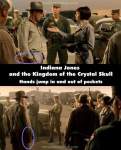
Indiana Jones: Put your hands down, will ya? You're embarrassing us.
Question: Why did the nuke fridge scene cause so much controversy?
Answer: Another problem is that people couldn't articulate what they didn't like about the film, and point to the "Nuke the Fridge" scene as a quick example of what they think is bad about it. In the realm of Indy, it's really no more outlandish than jumping out of a plane in an inflatable raft like in Temple of Doom.
It's considerably more outlandish. The raft scene was recreated/reviewed by Mythbusters, and they found that the raft floated down at a mere 22 mph. It would be hard/impossible in real life to stay on the raft, sure, but if you buy that bit of movie cheekiness, it would definitely slow their descent enough to survive, especially since they land a) on a slope and b) on soft snow. The fridge scene, however, has no such saving grace... it's completely ridiculous and unrealistic in every detail.
Answer: People felt it was ridiculous and cartoonish, even by Indiana Jones standards. Even if it was possible to survive a nuclear blast via the lead lining of a fridge (it's not), or that the fridge would simply be thrown away rather than be melted/torn apart like everything else in the vicinity (it wouldn't), the impact of being flung what appears to be a mile or so through the air, then violently crashing into and rolling over the ground, would certainly kill anything inside. The controversy arose because usually, in "classic" Indy films, the fantastical elements were exactly that: fantastic, magical, and/or supernatural. This was presented as taking place in our reality, with no "power of God" or magic spells, and for many, that was just too much disbelief to suspend.