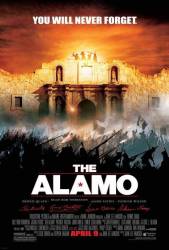
Factual error: The song that Davy Crockett plays on the violin is 'The Mockingbird Quick-Step,' written in 1855, several decades after the events of this movie (and later used by the 'Three Stooges' as a theme song.).
Factual error: In reality, the chapel of the Alamo was much further back then what you saw in the movie. In fact, it didn't even border "Alamo Square", the large area of land in the middle of the surrounding buildings and walls. Instead, it had its own little square courtyard in front of it, and a small wall leading to the chapel's courtyard bordered "Alamo Square". In other words, the chapel itself was about 30 to 40 feet behind the rest of the walls and buildings.
Factual error: In the scene where Houston is in Gonzales and when Guinan rides up to him, there is a shot of soldiers in the background and you can plainly see that one of them is wearing a pair of modern, zip-fly jeans.
Factual error: A marker at the real Alamo says that Travis and Bowie blew up the buildings that day. David Crockett never left the Alamo.
Factual error: The cannonball that Travis cuts the fuse off is way too big for the Mexican artillery. The largest cannon they had at the battle was an 8 pounder, meaning a ball about 4 inches wide. A cannonball as big as the one Travis carried would have been at least 100 pounds.


Answer: It is Viva Santa Ana meaning "Long live Santa Ana." Santa Ana was the leader of the army.