Continuity mistake: The position of the needle and thread lying on Peter's body differ in the wide shot and following close-up. (01:59:10)
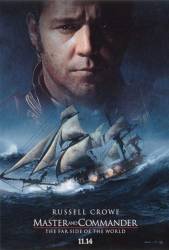
Master and Commander: The Far Side of the World (2003)
Plot summary
Directed by: Peter Weir
Starring: Russell Crowe, Paul Bettany, James D'Arcy
During the Napoleonic Wars, the British naval frigate, HMS Surprise pursues the Acheron, a large and powerful French war vessel sailing in South American waters. The Surprise, commanded by Captain Jack Aubrey, is attacked by the Acheron. The ship is badly damaged and many of the crew wounded. Even though the Surprise is outnumbered, outgunned, and their cannons are unable penetrate the French vessel's hull, the captain decides to capture the Acheron at all costs.


More mistakes in Master and Commander: The Far Side of the World
Capt. Jack Aubrey: To wives and sweethearts - may they never meet.
Trivia: Paul Bettany describes the scenes in which he collects insects: "I don't like insects. They tend to scamper and scuttle, so it was difficult." He also practiced for his self-operating scene by sitting "at home and [trying] it with a butter knife in front of the mirror."
Question: Will someone explain to me navigation. I have never heard of "Sou Sou West" or "Sou East by East."
Answer: There are four major directions (North, South, East and West), four minor (North East, south east, south west and north west) and 16 sub directions. Among these are South South West and South east by East. South South West is between South West and South and South East by East is between south east and east.
SexyIrishLeprechaun