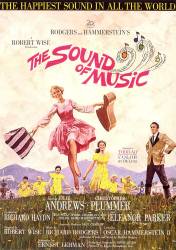
Character mistake: Liesl sings "I Am 16" with Rolfe before she is ever taught to sing "Do Re Mi" by Maria. We are led to believe the children have no concept of singing, so how was she able to sing this song before learning to sing? (00:41:00 - 00:42:00)
Suggested correction: They certainly know about singing. It's just been banned in the house since their mother died. Liesl, as the oldest, would have had the most experience of it.
Corrected entry: When Max is driving with the Baroness (and later the Captain as well), his Mercedes is right-hand drive. He might have been a cosmopolitan fellow who bought his Mercedes from England, but that seems unlikely since Germany was a bit closer. They seem to have tried to hide this by having the Countess drive the men around.
Correction: Max is never driving alone with the baroness in the movie, and the baroness never drives them around (there isn't even a Countess in the movie), and when Max, the baroness, and Georg are riding, Georg is driving them, and the only other person to drive the car in the movie is Max, when he drives the children home (right before Captain and Maria return from their honeymoon).
Austria drove on the left before Germany took it over, so a right-hand drive Austrian car was correct for the time.
Corrected entry: After the boat overturns on the lake, and Maria is on the terrace in debate with the Captain, she ends with "I'm not finished" He responds with "Oh yes you are, Captain" then pauses and says "fraulein" [correcting his quite obviously misspoken dialogue with an embarrassed expression on his face; and then the camera captures Julie Andrews' surprised expression when he mistakenly calls her 'Captain'].
Correction: It's not a mistake in the film, it's Captain von Trapp being flustered and misspeaking. It's written this way in the play too.
The dialogue in the play is not the same. The line "Oh, yes you are" doesn't appear at all. (https://archive.org/details/sound-of-music-script-1/page/n49/mode/2up) That doesn't mean the word "Captain" was unintentional in the film; lots of the lines were adjusted. But the play's dialogue in this scene doesn't shed any light one way or the other.
Corrected entry: The green dress Maria wears when she returns to the von Trapps is the exact same dress as the new postulant is wearing as she enters the Abbey. My guess is that the new postulant was Julie Andrews' understudy and was used in the scene instead of casting another actor or extra. (02:01:02)
Correction: As she said earlier in the film, when women join the convent, they donate all their worldly clothes to the poor. Maria likely did that when she returned from the von Trapp household. As the new girl was joining, she had to give up her worldly clothes. Since Maria was sent back to the von Trapps right after this, she likely grabbed this dress so she could get back there. As this is a film and not a play, Julie Andrews would not have an understudy, as they would have to reshoot the entire film anytime her face is visible.
But the night she returns, she wears the blue dress she wore during the puppet show... which she would have given away.
Given how quickly she left, and the emotional upheaval she was going through at the time, it's likely Maria left some or all of her clothes behind, either on purpose or merely forgetting.
Factual error: The von Trapps are shown walking over the border to Switzerland after a short drive out of the centre of town...except Salzburg is about 200km east of Switzerland. If one walked across the border at Salzburg, you'd be entering Germany, which is where (I believe) the people they were trying to get away from lived. Take a look at a map.
Suggested correction: Even though the von Trapps were 200km from the Swiss border, in the last 5 mins, they received a car from the sisters at the convent and the sisters disabled the cars of their pursuers.
Captain Von Trapp was clear, when they were about to hide, that they would drive into the mountains in Salzburg (which the movie did a close up on to show it was those mountains specifically) and walk over them on foot confirming the movie is pretending those are mountains into Switzerland. The director himself admitted this when the real Maria Von Trapp complained of this error. He said "In Hollywood you can make up your own geography."
Corrected entry: Maria is given material one night to make clothing for herself, because she claims the only dress she has is the one she is wearing. But the next day and in the rest of the movie, she wears dresses that are not the same color/style as the materials that she was given on her first night.
Correction: Actually, the material is used. For example, Maria is given a tan-ish, multicolor striped material which you see appearing as the upper half of the dress she wears not long after. It is deceptive and does not immediately look the same because the stripes are sewn diagonally (unlike originally shown), but it is, indeed, the fabric she was given.
The other dresses Maria wears are not from the darker materials she gets from the housekeeper - I do not see light blue or light green material in the fabric bolts. And does she make the play clothes overnight?
She could've got the light blue material on one of their trips to town and the greenish dress she wears is the one that she got from the postulant who had just joined the abbey when the Reverend Mother tells her to go back to the von Trapps.
Question: The scene where Maria and the children sing 'The Lonely Goatherd', there is a girl singing: 'One little girl in a pale pink coat heard' and 'She yodeled back to the lonely goatheard' (nearly at the end, the second time this is in the song). Who is singing here: Brigitta or Louisa?
Chosen answer: This line occurs 2:15 into the song. We see the singer is Brigitta (dark hair), played by Angela Cartwright, and not blonde Louisa, played by Heather Menzies.
They stated 'the second time' which implies the time that the verse is sang by the 'goat' family. In which case you can't see who is singing. You can only see who sings it the first time these words were spoken.


