Factual error: You can see the 3 point line painted out on the basketball court, they never had 3 point lines in the 50s. (00:21:55)
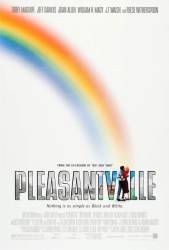
Pleasantville (1998)
Plot summary
Directed by: Gary Ross
Starring: Reese Witherspoon, Jeff Daniels, William H. Macy, Joan Allen, Tobey Maguire
Dweeby David is eager to stay up and watch the marathon of his favourite golden oldie, Pleasantville. Unfortunately, socially-active twin sister Jennifer also plans to use the television. They fight over the remote and it breaks, summoning a mysterious little fellow (Don Knotts) to their door in a TV repair van. He quizzes David on Pleasantville, and is impressed by his knowledge. He gives him a special remote, and when David and Jennifer fight over it, they are sucked into Pleasantville, where they become Bud and Mary Sue, two black and white teens with a Ward and June Cleaver-esque pair of parents. Bud tries to fit in but Jennifer, confident that "nobody is happy in a poodle skirt" slowly draws the reality of change and desire out of the people of Pleasantville, who slowly begin to turn colour. As Jennifer discovers that she has a serious side as well and David learns he's able to speak out when he has to, leading their "parents" to discover their own inner desires, the conservative mayor tries to fight the changes that he sees happening in his little town, leading to a showdown in the town hall with Bud and the town behind him.


Answer: We don't see much of the "real world" after David returns other than his conversation with his mother. I am sure in time she would have been worried but there seem to be many unanswered questions which might make it not so simple.
Lummie ★
Considering that a couple of days in Pleasantville turned out to be just an hour in the real world, it's possible Jennifer could spend 3-4 years in uni and cone back with it being just a weekend in the real world. David could just make up something in that period she's gone.
Actually if a couple of days is just an hour than 3-4 years is more than 2 weeks.
lionhead