Visible crew/equipment: Inside the Royal Academy of Science, when the camera zooms in on General Fang's amulet, the reflection of the camera can be seen in it. (00:08:15)


Continuity mistake: When Passepartout and Fogg arrive at The Royal Academy of Science explaining about breaking the speed barrier, Lord Kelvin asks where his authorization is and mocks Fogg while laughing and lowering his right arm. When it cuts, his arm is back up to his stomach. (00:13:00)
Passepartout: I'm your new valet.
Phileas Fogg: Uh... I must commend the valet service on their impeccable foresight. But they know I only accept French valets.
Passepartout: Yes. Oh! Oui! Oui! I come from a long line of French valets. On my father's side. Very, very French.
Phileas Fogg: But your accent.
Passepartout: My father French. Never speak. My mother Chinese and never shuts up. All the children pick up her accent.
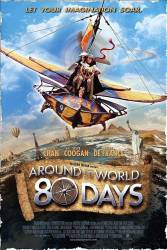
Trivia: The 2004 adaptation is a loose adaptation of the Jules Vernes novel. Instances include changing Phileas Fogg as an English gentleman into a gentleman-inventor; changing Passepartout to a Chinese thief from a French valet; and replacing an Indian princess with a French artist.
Question: When Passepartout, Phileas Fogg and Monique are looking at a map to find a way of avoiding the British police, Phileas notes that they can't go to Singapore or Hong Kong because they're both British Colonies. Monique asks if England owns every country in Asia, Passepartout says they don't own China. Since Hong Kong is located in China, shouldn't England own that as well?
Answer: Hong Kong was indeed under British rule from 1841-1997. In short, it stems from the First Opium War where in the aftermath of the war, China ceded (gave up control of) Hong Kong to the British. After the war, with the cession of Hong Hong, it wasn't technically part of China any more and Britain didn't really seek to occupy more of China.
Bishop73