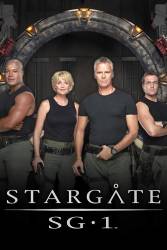
Question: When the present/future is altered, what was purpose of Jack, Sam, and Daniel going to recruit Teal'c? Was it just to recreate SG-1 so they could begin going on off-world missions? Did they even have a plan to fix the past/present (prior to Daniel being killed and they jumped back in time)? Then at the end, when the tape said there's no fish in the pond, wouldn't that Jack (Jack #3 if you will) already know there are in fact fish in his pond (since whatever changes to the past that affected the pond would also affect Jack #3)?
Question: Did Merlin reveal anything about his past to SG-1?
Question: Why did Richard Dean Anderson leave what was a very popular show?
Question: How long was Vala Mal Doran a host to Qetesh?
Question: Why is the star-gate kept a secret?
Answer: There were a number of concerns. Firstly, that the knowledge of a hostile alien race would lead to a mass panic amongst the population. Additionally, other nations would want to be involved and would be angry at the US military gaining advanced alien technology. This is seen as a valid concern in later seasons, when the IOA was set up.
Question: What was report 30185 and why wasn't Mitchell permitted to read it?
Chosen answer: Report 30185 is a joke report referring to the time when SG-1 go back in time to 1969 in the episode '1969'. The joke is that Colonel O'Neil knocked up a hippie and made sure Mitchel was taken care of throughout his life, like how he got into the 302 program while his buddy, a better pilot, did not.
Answer: This answer is incorrect, because after Mitchell said, I'm being parked on a Samantha, in a very serious tone, said seriously we can't tell you about 30185.
To clarify this entry, what Mitchell asked is "Oh, I'm being punk'd, aren't I?" The joke in the scene was 30185 was too classified for Mitchell to know, but then they turn around and tell Vala. O'Neill isn't really Mitchell's father, they were joking around. But then Samantha does honestly say they can't tell them about 30185. From there we never learn what it is.
Question: When SG-1 are going to P2X-555 (I think) they get sent back in time. Why do they come out in Cheyenne Mountain instead of the boxed stargate in Washington DC?
Answer: Carter explained it in the episode. For a brief moment, they were present in both time periods, which allowed for the Stargate to be there for them to step out of. Agreed, it does make more sense for the Stargate's unstable vortex to punch through its packing crate, but then you wouldn't end up with the hilarious "I'm Luke Skywalker" scene.
Question: Maybourne threatens Daniel with a court-martial if he continues to disobey orders by helping the Tollan. The driving force of him helping is the idea that since he's a civilian he can't be court-martialed. But how accurate is that? Can a civilian who works for and/or with the military be court-martialed, especially if he or she has participated in military operations? The Stargate program is essentially a black-ops program and Daniel signed an NDA, so how could he ever face a non-military court?
Answer: In real life, under certain conditions, civilians working with military forces can be required to abide by military law as well as the civilian laws of their nation. This is usually when civilians (eg. scientists, contractors, etc) are deployed for a lengthy time as part of a military force at war (or similar operations). The requirement to abide by the law is usually explained carefully to the civilian and signed before deployment. This helps fit civilians into a chain of command and maintains discipline, without having to return to courts in the home country for infractions. There may be many parts of military law that don't apply to the civilian (e.g. alcohol is forbidden to all personnel, but the civilian does not have to have a regulation haircut). Also, very serious crimes by anyone in a force may be dealt with by civilian courts, if the military can't for some reason. So it is feasible that Daniel would be subject to at least some parts of military law (and civil law too).
Question: Why does the USAF pronounce the word 'lieutenant' as 'loo-tenant' whilst the RAF and RAAF pronounce it 'lef-tenant'? I realise there are different spellings between countries (aluminium and aluminum, for example) but the word lieutenant is spelled identically in the US and UK, yet still pronounced differently. What's the specific reason for the different pronunciation of this word?
Answer: No-one seems 100% sure. The closest we can get seems to be that the spelling and pronunciation evolved differently - the current spelling comes from the French - lieu tenant = place holder, ie. someone who acts in place of an absent superior. The pronunciation appears to have derived from English ears hearing the "w" sound in the French pronunciation as something closer to a V or F (certainly possible if older French pronunciation was anything like, say, modern German, where words such as "wunderbar" are pronounced "vunderbar"). This site (http://archiver.rootsweb.com/th/read/OLD-ENGLISH/2000-11/0973487763) quotes some examples from the 12th century onwards of English spelling, with the first syllable varying between "luff", "lieve", and "Leif". The French spelling seems to have eventually become the standard, but the mis-pronunciation remained, possibly as it was so widely used already. When America declared independence they made an effort to shed many effects of English influence (such as gradually switching to driving on the right). Noah Webster (of dictionary fame) encouraged the independent development of American English, and came up with the American Spelling Book, which pushed spellings and pronunciations in the US rapidly towards their current forms, including the more literal pronunciation of the word "lieutenant".
Question: When Colonel O'Neill is telling the scientist not to go after the unknown alien and Teal'c tells them to listen to him, he says "thank you, Rocco." Who or what is O'Neill referencing?
Answer: In almost every gangster move from the 1930's, there was always a guy named "Rocco." A dumb but lovable guy who always agrees with the Boss. When everyone disagrees, he always says "Listen to the Boss." or "Do what the Boss says."
The Serpent's Lair (3) - S2-E1
Question: How did Daniel get into the sarcophagus all on his own in order to heal his staff weapon wound? Then how did he operate the sarcophagus while inside it? Finally, how did he get it to open while inside it? How lucky that he got it opened in time to escape through the gate. Or maybe the real question is, who loaded him in, healed him, and then released him without ever being seen?
Answer: The Goa'Uld who use it do it by themselves as well as observed on many occassions. The sarcophaguses are fully automated. You open it, get in, the thing closes on its own and after a certain period (after the wounds are healed or some preset time) it opens again.
Question: When SG-1 travels to alien planets they always experience earth like gravity. Shouldn't they be experiencing different gravity on different planets?
Answer: Basically, if a planet has the same mass and size, it will have the same gravity. Since the Stargates were placed on habitable planets, it's likely they placed them on planets with the same gravity. Even if the planet's varied in mass or size, a planet's gravity in relations to Earth can be calculated as m/r^2where m is the planet's mass compared to Earth's mass and r2 is the planet's radius (compared to Earth's) squared. So if a planet had 50% the mass and 70% radius of Earth, gravity would be 0.5/0.7^2 which would be 1.02 times the gravity of Earth (or roughly the same).
Answer: Goldilock zone.
What does this answer have to do with the question?
Nothing, just someone trying to be clever.
Question: Either it was explained in this episode and I missed it or maybe it was explained in a later episode and I haven't seen it yet, but I have always been curious. If the Asgard were able to remove the Goa'uld from Skaara, then why couldn't they do the same with Teal'c?
Chosen answer: Skaara has a Goa'uld in his head controlling him. Removing it returns him to a normal human being. Teal'c has a Goa'uld in a sac in his stomach. The Goa'uld in Teal'c acts as his immune system and helps him to have a very long life span. Removing it would kill him.
Question: Why didn't the Asgard participate or help in the ongoing war with the Ori?
Chosen answer: They have very little resources left after the war against the Replicators.
Answer: They did. There was an Asgard ship present during the battle at the second super gate (the battle in which the Korolev was destroyed). The Asgard ship's fate in unknown, but it is implied in dialog between Landry and Woolsey (which specifically mentions the Asgard being there) that it was either heavily damaged or destroyed like all the other allied ships present. Aside from that, yes, the Asgard did play very little role in the Ori campaign.
Question: Why did Corin Nemec leave the show?
Chosen answer: He left the show because Michael Shanks decided to come back to the show the next season.
Question: In this episode who are the hippies, and why are they so important? Their names were Michael & Jennifer, and when the team are going back to the future the hippies wanted to go also, but Jack started to tell them something and then stopped. I just want to know if they are someone from future episodes or something.
Chosen answer: Michael and Jennifer have never showed up past this episode. SG-1 led them to believe (with the help of a Zat gun) that they are aliens, they never told them they were actually from the future. They were simply a couple of nice people willing to help.
Question: When they are repairing the cargo ship on Revanna the scientists talk about what happened in the episode Tangent. They talk about the recall device. I don't really understand what it is that O'Neill is accusing the scientists of. Could someone explain it to me please?
Answer: In Tangent, a captured Goa'uld Death Glider was retrofitted into the X-301. Unbeknownst to the SGC, it contained a recall device that would automatically make it return to Apophis home base. Teal'c and O'Neill were testing it when the device activated sending them into deep space where they nearly died. O'Neill wants to make sure the cargo ship doesn't have something similar.
Question: I've recently noticed while watching my collection of Stargate SG-1 tapes that one of the team, with the possible exception of Teal'c, seems to say an obligatory "What?" in each episode in such a way that it seems like a ritual signature of the series or an inside game being played by the cast. Has anyone else noticed this, and is it done in each and every episode?
Answer: I can't say I've noticed it every episode, but I agree it happens a lot, most noticably with Daniel Jackson and O'Neill. With the amount of exposition Carter and Jackson have to deliver each episode, after saying "What?" it tends to lead to a long technical or archiological explanation, I wouldn't be suprised if it had now become an in-joke. Much of season 8 seemed to be in-jokes and digs at the show in general.


Answer: While the series was undeniably successful, filming it is a long process, taking many months of often long days. Anderson, after several years of doing this, wished to spend more time with his young daughter, who he felt he was neglecting, and requested that his role in the series be scaled back. Ultimately, he decided to leave the main cast altogether and only make occasional guest appearances.
Tailkinker ★