Factual error: The Master-at-Arms office, where Jack is handcuffed, was in actuality an inside cabin and had no portholes at all. (01:51:10)
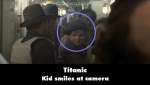
Revealing mistake: When Tommy, Jack and Rose are trapped down the staircase with a lot of other people, during the shot where Fabrizio is running towards Jack, look on the right portion of the screen. You can see a kid with a hat on, being carried around by his mother, who deliberately grins at the camera. (02:03:40)
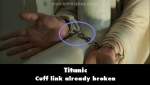
Revealing mistake: When Jack spreads the handcuffs over the pipe, we have a very clear close up shot of the links connecting the cuffs. In this shot you can see that the link nearest Jack's right hand is broken and not a complete link, therefore he should be able to separate the cuffs without going through the axe sequence. (02:00:05)
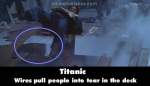
Revealing mistake: As the ship is breaking apart, you can see the wires that pull people into the tear on the deck. (02:40:10)
Factual error: It is fairly well known that James Cameron built a virtual full-size replica of the ship for shooting the exterior scenes. However only the starboard side of the ship was constructed in full, facing land (port side only down to B deck); when scenes were required that need to show port side Cameron generally employed a method known as 'flipping.' For example, in the early scenes of the film we see Titanic at 'Southampton' and passengers boarding the port side. This was achieved by reversing the camera angles. All the signs on passing carriages/vans and White Star logos were printed back-to-front so that when the scene was printed it could be reversed, thus showing both sides of the ship. The problem is that in reality the starboard side of Titanic was not a mirror image of the port side. On one side of the forward boat deck there were entrances to the First Class Gymnasium and forward Grand Staircase, while on the other side there were the windows of the Officers' Quarters and the entrance to the Wireless Room. On Cameron's Titanic you get to see the gym etc. on both sides of the ship. (00:20:20)
Factual error: A small one & probably only noticed by dog trainers like me. When the dogs are being brought on board, they are on leather leashes made by J&J Dog Supplies, invented in the 1970s. It is the type of leash preferred by professional trainers, who probably supplied the dogs for the movie, and is distinguished by the "braid" near the snap, rather than by a sewn or riveted section. J&J's website is: www.jandjdog.com. You can see the leashes there. (00:22:50)
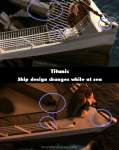
Continuity mistake: The design of the ship's bow changes significantly while at sea. The white form on top of the bow used for mooring first does, then doesn't have an indentation on top, possibly with a bolt in the center. The point where the curved railing meets the straight side railings either is or is not connected by a top horizontal bar, and the gap between the vertical posts changes size. Another mistake on this site mentions the anchor design change, but also the metal walkway is made of tubular metal bars -or- flat bars that are more numerous and closer together. (00:30:15 - 01:21:00)
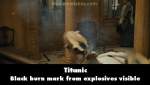
Revealing mistake: When Cal shoots at Rose and Jack he hits a decorative wooden structure on top of a banister. When the piece falls apart you can see that it has been neatly cut in the middle, and you also see the explosive device that blew it apart. (02:14:40)
Continuity mistake: When one boat drives back to search for survivors, you can see the lightspot of one lamp turn around faster than the man who hold this lamp, so you know that the lightspot is not from the lamp of this man, but from a studio lamp. The man sees that himself and turns around very quickly to hold the speed of the spotlight. (02:45:45)
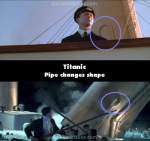
Continuity mistake: The pipe on the starboard side of the forward smokestack changes by the time the ship sinks. When Captain Smith tells Murdoch to speed up the ship it bends at the top and creates a half circle. When it is collapsing behind Cal, it has the shape of a "P." (00:28:20 - 02:28:00)
Continuity mistake: When Rose is being lowered into the lifeboat, she looks up at the ropes, and then the camera alternates between her and Jack/Cal four times. The shots are only a few seconds apart. In the first shot, Cal's hands don't extend past the rail and Jack's are clasped resting on the rail. In the second shot, Cal's hands now extend over the rail and Jack's are completely gone. (The third shot doesn't show the rail.) In the fourth shot, Cal's hands again don't extend over the rail and Jack's are holding the rail. Jack and Cal are calm throughout, so would likely not have been moving their hands about. (02:12:40)
Factual error: When the stern (back) of the Titanic is rising into the air, there is one shot where it appears bone dry. Easily hundreds of gallons of water would have been pouring off the still wet hull. (02:34:10)
Factual error: Rose and Jack retreat aft of the 3rd funnel while D deck (1st class dining salon between funnel 2 & 3) is being flooded. They go down to E deck, which floods then they come back up to D to the locked gate, then escape to C deck just as D floods to the top. The 1st class dining salon extended across the entire width of the ship, so D deck was flooded to ceiling aft of 3rd funnel at the time they escaped below decks. In reality, if the ship were flooded that high, only the stern would be sticking above water. The 'split' did not even show the water that high and far back in the ship. (02:20:25 - 02:25:30)
Continuity mistake: During a scene where the ship is sinking, Jack and Rose are seen in front of a roaring fire. The coal or logs on this fire do not roll off despite the acute angle of the ship. A clock, glass and ornaments on the mantlepiece above the fire do not slide off and if you look closely at the half filled wine glass on the mantle, the wine is completely level despite the room tilting further and further. (02:25:35)
Continuity mistake: When Rose and Jack are running down the corridor after the water breaks down the doors and comes rushing in, Rose has on flat shoes instead of heels. This was probably done for safety reasons. (00:34:30)
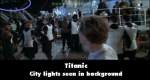
Revealing mistake: This mistake, as far as I know, can only be seen in widescreen. After Rose, Jack, Tommy and Fabrizio have run on deck (after breaking the gate down), the camera looks down the ship toward the bow. If you look at this carefully, you can see city lights in the top-left hand corner of the picture. I know these are city lights because in a book about the movie, it shows a similar picture. Fixed on Blu-ray. (02:08:05)
Continuity mistake: Rose is wearing low heeled laced shoes throughout the entirety of the sinking scenes. Jack helps her jump off a small deck in order to flee for the lifeboats (she's wearing her lifejacket at this point). In this scene, Rose is suddenly wearing flat moccasin-type shoes of similar bone colour. Shoes then revert back to low heeled lace-ups after small jump assisted by Jack takes place. (02:28:30)
Continuity mistake: At the beginning of the film, when Brock is being taped in the submersible, the sub is already underwater. Only seconds later, if you look out the circular window, it's the reflective tops of the waves. Did they just rise up to the surface suddenly? (00:03:20)
Factual error: When Jack and Rose are running through the boiler room not only is there no door between boiler room 6 and the cars but the cars were kept two decks higher, and there was a shaft between them. (01:29:30)
Continuity mistake: When Jack shouts he is king of the world, the shadows at the bow of the ship (where Jack and Fabrizio are standing) are shorter and point to the right. On much of the rest of the ship, they are longer and the angle is very different, pointing closer to the stern. (00:32:55)


Suggested correction: I checked the plans. It's an outside cabin.
It's an inside cabin per the deck plans. Https://www.encyclopedia-titanica.org/titanic-deckplans/e-deck.html.