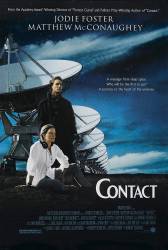
Corrected entry: There's a scene where Ellie sleeps with Palmer, then gets up quickly to go to the lab. In her haste, she departs whipping on a shirt with no bra. If she had a bra inside that tight T-shirt the contours of the cups and straps would be visible and we would see her fitting and fastening it, instead she steps outside where suddenly it appears she is now wearing a bra.
Corrected entry: The simple fact that they overlooked the opportunity or chose not to repeat the experiment with the same or different machine to get a "second opinion" seems like a pretty big hole to the answer almost all the higher ups were asking. Easy enough to find a volunteer now that the first person to go through survived.
Correction: This is an opinion. The project cost a lot of money to built, a lot of people were opposed to it and then was destroyed with the costs of several lives. Only in secret did someone go through and come out alive, without anything happening, or so it appeared. They concluded it was a hoax set up by Hadden.
Corrected entry: After the space pod splashes down in the ocean, it floats on the surface. But when they show Ellie from inside the pod after landing; there is absolutely no movement of the pod, and it's obvious the space pod is not resting on water. Even if it were hanging suspended in the air in the rescue net, its motion would still have it rolling around slightly after impact. But the footage from inside the pod shows the pod to be completely still without any movement, as Ellie asks how long she's been gone.
Correction: The pod is a spherical 'cockpit' suspended with in a honeycomb shaped framing. The framing could be some form of low-friction suspension which could eliminate all movement from inside.
Corrected entry: When Angela Bassett is speaking during the Press Conference, she mentions that the Signal was discovered at 6:31 a.m. Mountain Time. New Mexico is probably in Mountain Time zone, therefore this time would be accurate in the early morning. But Ellie actually discovers the Signal while lying on her car during the evening/dusk, and rushes back to the control room, where they work through the night processing the signal and discovering the Primes. In fact, one of the guys working there mentions that they have to do something soon, as Vega would be setting, meaning it was becoming night.
Correction: She misspoke. She should have said the signal was confirmed at 6:31 after verifying it from other sources in other countries. Because Vega was setting soon, they contacted Australia to track and confirm the signal. NM is in the moutain time zone. If anything it's a character mistake.
Corrected entry: When they contacted Australia to confirm the signal before Vega set, you can that hear Ellie's team still has the signal tuned in when they are talking to Australia. This couldn't have happened because Australia and US are opposite each other, therefore only one country could have been pointing to Vega at one time, not both. So Ellie's team shouldn't have been able to hear the signal because Vega was past the horizon and appearing on Australia's side.
Correction: Rubbish. Australia and the USA aren't even close to being opposites. Ellie is based in New Mexico, the antipode to which is in the middle of the Indian Ocean, approximately halfway between the western coast of Australia and Madagascar off the coast of continental Africa. It would entirely possible for the Australian team to pick up the signal before Ellie's team in New Mexico lost it.
Corrected entry: When Ellie goes into the pod and the door closes, the seam magically disappears while she's watching it. The pod was made of manmade materials and therefore, the seam should not magically disappear, and when it does disappear, she just blows it off like it's no big deal. Being a scientist, she should be freaking out or at least have mentioned it to mission control.
Correction: The 'pod' was constructed using instructions from an alien life form. It is entirely plausible, especially given what happens during the remainder of her journey, that the seam is just the first of a series unknown physics occurrences formerly unknown to humans.
Corrected entry: Ellie claimed her space trip lasted approximately 18 hours, but from what we saw it seemed more like 15 or 20 minutes at the most. She made it through the initial worm holes in several minutes, spent several more minutes on the beach with the Alien - and then as she later testified, an instant later she was beamed back to Earth as she splashed down. How does this possibly add up to 18 hours, when the trip was really only several minutes long? We were seeing the trip in her time, as it actually unfolded.
Correction: No we weren't seeing the trip in her time as it unfolded. No audience is going to sit through 18 hours of uneventful footage, so, as usual, they use time compression to give us only the highlights.
Corrected entry: When Haddon is showing Ellie's life story to her on his plane, he mentions that she turned down a teaching position at Harvard in order to do research work for SETI at Aericibo. But the video clips he is playing for her at that point show her actually teaching from a podium, using a screen behind her. This implies that she was physically teaching at Harvard, although in reality she never took the teaching position in the first place.
Correction: She could be presenting a paper at a conference, or making a budget proposal. Simply standing at a podium with a screen behind her isn't nearly enough to suggest that she's taken up a specific teaching position.
Corrected entry: Towards the end of the film, when they review Foster's footage of her supposed space trip, they note that about 18 hours of static has been recorded, but she was only off the cameras for a split second. Foster claims to have traveled to a distant region of space and claims the trip may have lasted for hours (the camera static supports this), and that the cameras on the machine may have only missed her for a split second "Earth time". But, this contradicts Einstein's special theory of relativity, which states that time will slow down for objects traveling closer to the speed of light (which Foster was doing) relative to objects at rest (observers on earth). If Foster truly traveled for almost 18 hours, as she states, and as her camera records, then it would be impossible for the stationary observers on Earth to see her gone for only a split second. They would have to had to recorded her as being gone for far, far longer than 18 hours.
Correction: A slightly technical answer, but Sagan has used another consequence of general relativity to get around the time-dilation effects of close-to-luminal velocities. The Einstein-Rosen bridge, or 'wormhole', is link between two distant points in space which allows matter and energy to travel between them without crossing the intervening space. Now the ?wormhole? get out is not without its own problems - which it is well beyond our current capability to even comprehensively understand never mind solve. Purely in theoretical terms though it would allow both for Ellie to travel to distant areas of the galaxy at (effectively) faster-than-light speeds, and also to (effectively) travel back in time by arriving back at her start point with zero time elapsed after a journey of 18 hours. Unfortunately the ?worm hole? has been used in a number of other slightly less fastidious sci-fi settings (Star Trek Deep Space 9, Stargate SG-1) and might now be seen as being something ridiculous or impossible. Whilst the portrayal of wormholes in these programmes is often based more on fantasy than science, the underlying theory is sound, as one would expect from a scientist with Carl Sagan?s reputation. Indeed in his updates to the seminal factual series ?Cosmos?, Sagan mentions his discussions with Kip Thorne about the use of wormholes as a plot device in ?Contact?. For more information about our current understanding of wormholes see ?The Universe in a Nutshell? or ?A Brief History of Time? by Dr. Stephen Hawking.
Corrected entry: In the scene where the alien machine is activated for the 2nd time. The ships are shown to lean toward the machine (as a result of the gravity field it creates). Boats float orthogonally (horizontally) to the direction of gravity. If the machine generated a gravity field that "pulled" then the ships should be seen tilting away from the machine... in order to float orthogonal to the direction of gravity.
Correction: That would depend on the exact direction of the gravity pull. Since the centre of the machine (and hence the centre of gravity) is located several hundred metres above ground level, the force would attack at the upper structures of the ships. This would cause a tilting as it is depicted.
Correction: It could have been gravity pull or a magnetic field acting on the metal ship. Since the ship's lower part is inside water where drag is much higher, the upper part that is inside air would have tilted towards the pull.
Corrected entry: Although it appears that Ellie's trip through Space actually occurred, she claims it lasted approximately 18 hours her time. This is later confirmed from the video footage, which also lasted approximately 18 hours. But the space pod was not that large, and couldn't have possibly held enough oxygen to sustain life for 18 hours. There was no supplemental oxygen or oxygen production capability inside the pod, so the only air Ellie had to breathe was what was trapped inside the pod when the door closed. She was only on the beach for a few minutes, and even then it appeared she was still within the confines of the pod which is why she was able to breathe on their planet. So if she had only the pod air to breathe, how was there enough oxygen to last her 18 hours?
Correction: This entry relies on too much speculation to be a mistake. We know nothing of the nature of the 'beach' location or of the specifics of the alien technology.
Corrected entry: While Ellie is traveling through the wormholes, the chair tears away from the ceiling and then gets thrown toward the ceiling as the pod stops, apparently. The pod was made of man-made materials. Assuming she was traveling at about a bazillion miles an hour, the chair would have ripped right through that pod like paper when it stopped.
Correction: If you can buy that humans would be able to construct the transporter at all, then you can certainly buy that there may have been some kind of magnetic or force field that protected the physical integrity of the pod. Besides, the film establishes that the events that took place during Ellie's interstellar journey didn't physically occur (if they occurred at all). It's unclear whether the chair was damaged at all after she "returns."
The events did physically occur, she physically travelled through wormhole (and therefore she didn't necessarily travel a bazillion miles an hour, as a wormhole is a shortcut between two locations). The real question here is, why did the chair crash against the wall when Ellie and the compass were weightless and floating? Obviously the crash was not caused by speed but just by the magnetic field (it was a metal chair). As such, it would not have crashed through the wall.
Corrected entry: In the part of the movie where Ellie is traveling through the worm holes, in one scene it shows the restraint seat getting crushed against the top of the pod she's traveling in. However, when the camera shows Ellie inside the pod after she lands in the water, over her shoulder you can see the restraint seat in good condition. I realize some could argue that her trip never happened, but the special finding report, discussed at the end of the movie, proves her trip did in fact happen since her camera recorded 18 hours of static. Therefore, her restraint should have been crushed when the camera was showing it at the end of her trip.
Correction: The seat is not in good condition. Ellie is lying on floor of the pod and the crushed seat is next to her, with its light flickering.
Correction: 18 hours of static is not conclusive proof the trip happened. And it's certainly not proof that the trip occured the way Ellie experienced it. Like everything else about the journey, it's an ambiguous piece of evidence open to interpretation that proves nothing. Ellie experienced the chair being crushed, that doesn't mean that it physically happened any more than her actually physically being on an alien beach that looked just like her painting of Pensacola. It's simply how the experience looked to *her*.
Corrected entry: Ellie drives her jeep to confront Drumlin after learning he's pulling the plug on their research funding. She begins her typical argument, "there are 400 billion ." and he cuts her off with, "two possibilities: 1) they're so far away you'll never contact them, or 2) there's nothing out there but noble gasses and carbon compounds" . (ahem) the top 10 elements of which our local sun is comprised are: Hydrogen, Helium, Oxygen, Carbon, Nitrogen, Silicon, Magnesium, Neon, Iron and Sulfur (that's two noble gasses out of 10 ?) and isn't carbon-based life what they're looking for? so . carbon-compounds wouldn't be a bad thing to find, now would it? (00:26:45)
Correction: Drumlin's being sarcastic. (1) This is not intended as a serious scientific statement. We all know that there are other elements out there, and so does Drumlin. (2) Ellie's using a radio telescope. (ahem) Do you really think that carbon compounds are noted for sending out radio waves? They don't, so she's not going to find any. And, just for the record, neither do noble gases. Which merely emphasises the point; Drumlin's just being sarcastic about her chances.
Corrected entry: When Ellie discovers her father has died, as she descends down the stairs from the second floor, the stairwell is on the left side of the center hall (relative to the front door), and the room where the spilled popcorn comes from is on the right side of the center hall. When she turns to run up the stairs, the shot is flipped, with the stairs on the right side of the center hall, and the room with the spilled popcorn on the left side. (00:21:55 - 00:22:30)
Correction: When Ellie reaches the medicine cabinet, it is revealed that the shot of her running up the stairs was shot into a mirror. That is why it is flipped.
Corrected entry: Some of the world's most brilliant physicists would have been involved in the project, but when they see Ellie's capsule drop straight through to the bottom, they all dismiss the project as a failure and no one seems to back Ellie's testimonies. How could these physicists neglect to weigh up all the different possibilities? After all, they are conducting an experiment that is far beyond conventional science. Ellie herself is a brilliant scientist, so how did she neglect to check the footage recorded by her helmet cam and use it as evidence?
Correction: From the scientist's point of view, everything occured instantaneously. They thought the project was a failure precisely because it appeared the capsule dropped straight through to the bottom. Ellie's testimony could have been disregarded as a hallucination, or wishful thinking at best, especially with her talk of the alien looking like her father. As for the helmet cam, it was immediately taken from her when she was unconscious, and partially erased by those involved in the cover-up.
Corrected entry: In the public inquiry at the end, Ellie says she was gone "approximately 18 hours". But this contradicts what she says right after the capsule lands: "What day is this? How long was I gone?" So how did she come up with 18 hours? We do find out after the inquiry is over that her headset, conveniently, recorded 18 hours of static, but this was kept secret by the investigating committee. So Ellie didn't know that; in fact, she had no way of knowing how long she was gone.
Correction: It's not remotely unreasonable that she couldn't have worked out an approximate timeframe later on, once she'd had to time to reflect on her experiences. She also knows that she's travelled through what appears to be a wormhole - under those conditions time can (and, as we find out, has) run strangely, so she has no real idea how long she might have been gone from their point of view, so her question is hardly unreasonable.
Corrected entry: Hadden tells Ellie that the zero gravity and low oxygen environment aboard Mir is slowing the progress of his cancer. Quite apart from this being medically absurd, he isn't breathing Mir's atmosphere - he has a nasal air line installed.
Correction: A zero gravity environment can have drastic effects on the Human body, such as decrease in body mass and less muscle strength, to name a couple. It also causes the body to lose a great deal of fluid which would normally be forced down into the abdomen and legs by gravity. (This is why Shuttle astronauts have to force-drink mass fluids just prior to re-entry, to avoid light-headedness from the pronounced lack of fluid their bodies are still experiencing while re-entering a gravity atmosphere). It's possible theoretically that zero-gravity could also have an effect on aggressive cancer, and the entire premise of this movie is theoretical. Also, the nasal line could be to make it easier for Hadden to breathe in his weakened condition, adding some oxygen, but at the same time he was still breathing in the overall atmosphere inside the Space Station as the line wouldn't completely block his nose and mouth.
Corrected entry: After the signal from Vega has been established to contain an encrypted message, some of the world's most skillful cryptographs are set to decrypt it. After weeks without any success, Mr. Hadden finally reveals the solution to Ellie - the squares making up the message have to be put together like cubes rather than in a 2D grid. This seems fair enough from a cinematic point of view, because it gets Ellie back on the track. However, it is hardly logical. In reality, one of the first things a skillful cryptograph would do when getting those squares with markings in the corners would be to try putting them together like cubes. Thus the message would have been decoded in much less than a week.
Correction: Simply because you think that is the first thing they would do doesn't mean it is a movie mistake. It's kind of like all the people in scary movies running upstairs. Character mistakes.
Corrected entry: When Jodie Foster comes down off the helicopter, she and Tom Skerritt are interviewed on the spot (that happens minutes before the explosion of the first engine). This interview last about 3 or 4 minutes, at most. But if you look in the background, you will see a countdown panel. At the beginning of the interview, it shows 2h01 and at the end, it shows 1h53 instead of the expected 1h57.
Correction: There was a time lapse and they didn't show the full interview.


Correction: My wife read this posting and then demonstrated how Ellie did it. In the heat of the moment during the previous evening Ellie peeled off her t-shirt and bra together and tossed them aside. In a hurry the next morning she slides the whole assembly over her head (the bra is invisible inside the t-shirt) and jiggles herself into place (if you see what I mean) and away she goes. I have to admit to being very impressed but if my wife can do it, Ellie can, too.
Entertaining though this is, it is wrong. Ellie pulls on a tight T-shirt and if there was an unfastened bra inside it we would see the contours of the cups and straps, and we would see Ellie fitting and fastening it. We see nothing of the sort. The bra appears as if by magic. The posting is correct.