Corrected entry: The astronauts are shown taking their suits off before docking, but in real life they were not allowed to do this, in case of sudden cabin depressurization.
Corrected entry: Jim Lovell tells his son that it will take him and his crew 4 days to get to the moon, but when the crew is getting their pictures taken by the media the journalist says Apollo 13 is expected to enter the moon's gravity in April 13, only two days after liftoff on April 11. So where is Lovell getting this 4 days figure from?
Correction: The moon's (and Earth's) gravity field extends well beyond the physical object. The Apollo spacecraft entered the moon's sphere of gravitational influence around 60 hours after liftoff (2:13 pm local time). Therefore they would have reached the moon's gravity late on the 13th or very early on the 14th. It's likely the reporter was just being approximate with his estimate, not exact. It would have been about 4 days post-launch before Lovell and Haise landed on the moon (I doubt he would have told his young son that it takes about 3 days to get there, then they have to establish orbit, check instruments, get the LM ready, then land). Therefore, both are basically correct.
Corrected entry: When the astronauts are preparing to dock with the Lunar Module, one of the people in Mission Control says, "If Swigert can't dock this thing, we don't have a mission." In fact, all three crew members were trained to peform the LEM docking, and had Swigert run into any trouble, Lovell or Haise could easily have done the procedure instead. This is confirmed in the DVD commentary.
Correction: Presumably Swigert is the best trained since this is his primary task, it's a reasonable, if not necessarily correct, remark to assume that if he can't do it then nobody can.
Someone in mission control says it in a voiceover that seems like it was added for exposition to build tension for the audience related to the "Jack is new to the mission" subplot. The idea that someone in mission control would be unaware of the cross-training of the astronauts to handle each others' tasks in an emergency is a dubious claim at best. And Lovell had served as the CMP on Apollo 8 (which admittedly didn't have a LM to dock with, but he was certainly familiar with how to fly and dock the craft).
Corrected entry: In the scene where Tom Hanks' wife is in the shower and drops her wedding ring down the drain, when she bends down to try and catch it, you can see the stick-on bra and light green underwear she is wearing for modesty purposes. Hard to catch it in full speed, but try frame by frame. Guess she (or director Ron Howard) didn't want to take any chances of nudity getting into the film.
Correction: As is stated in the rules of this site, if a mistake requires frame-by-frame to spot, it's not considered to be valid.
Corrected entry: The real Jim Lovell is left handed and if you noticed Tom Hanks when he is writing down information is right Handed. Tom refused to attempt to write left handed.
Correction: He did not "refuse". He simply couldn't master the necessary skills in the time required. Nobody could - try it to see how long it takes.
Corrected entry: In the shot where Jim is with Marilyn, outside of their house right after the Apollo 11 landing, he blocks out the moon with his thumb. In the final shot, where he puts his finger in front of his face to hide out the moon again, you can see the shadow below his chest. It should be on his eye.
Correction: This is one of the most frequently quoted "non-mistakes" of Apollo 13. It is valid only if the moon was the ONLY light source in the scene, and it is not. There are three or four strong porch light to screen right. Moonlight is pretty feeble and the lights cast the far stronger shadow.
Correction: The only porch lights visible in the scene appear to be behind the actors and were a yellowish color. The light on both characters faces is white and intended to portray the moonlight. Even if the 2nd source of light was shining right on Lovell's face, the white light of the moon would have cast some kind of shadow from his thumb over his eye, particularly at the start of the scene while he was standing up. During that sequence, no shadow of his thumb could be seen anywhere, not even on his chest.
Corrected entry: When Marilyn is talking to NASA on the phone, the phone has a modular connector in the handset. This would be fairly impossible since AT&T did not start installing them in houses until 1976. Prior to that they would have been hardwired. (01:03:40)
Correction: From Wikipedia: The first types of small modular telephone connectors were created by AT&T in the mid-1960s for the plug-in handset.
Correction: A friend of mine had modular phone jacks in her house in the early 70s. I don't know if she had them as early as 1970 but definitely before 1976.
Corrected entry: Okay, it's an accepted science fiction convention, but "Apollo 13" is supposed to be an authoritive, documentary-style film about a failed NASA mission, not a Buck Rogers space opera. So did there really have to be sound in space in this film?
Correction: It's supposed to be a reasonably intelligent portrayal of the Apollo 13 situation - it's not and never was intended to be a documentary, nor is it particularly done in the style of one. Some things have been fictionalised, characters have been combined, eliminated and so forth - ultimately, it's still an entertainment piece. As such, there's no reason why it can't use some of the standard movie conventions.
Corrected entry: Near the end of the movie, when the Apollo 13 is about to return to Earth, a lady goes to collect the Lovells' eldest daughter from her bedroom to join the rest of her waiting family by the television. She appears to calls her Mary, the actresses real name, not Barbara the name of the daughter in real life.
Correction: She isn't Barbara Lovell, she was Fred Haise's wife Mary.
Corrected entry: Keeping the Earth in the window during the burn for trajectory correction is inaccurate because if the LM were pointing toward the earth, the window would be underneath the craft and the earth wouldn't be visible through the window. The earth is visible to be artistically consistent. This is mentioned by Jim Lovell on DVD Commentary.
Correction: Jim Lovell says he kept Earth in the window and that the LM was not pointing toward Earth. He says the LM was pointing 90-degs to the flightpath so that Earth could be seen through the window. The burn was not to speed up the LM, but to change the angle of approach to Earth, and that it was done while the LM was at a 90-deg aspect.
Corrected entry: When he finds out he is being bumped to the Apollo 13 crew, Lovell is giving a tour at the vehicle assembly building at the Kennedy Space Center in Florida. In the next scene, he runs into his house, which seems to be in Houston - over 1000 miles away - to announce that he's going to the Moon in April, then races off to get back to training. It seems like an awfully long commute.
Correction: When he gets home Lovell is wearing a NASA flight suit. It was very common for the astronauts (who were mostly military pilots) to fly between Houston, where they lived, and Kennedy Space Center. They would typically fly T-38 trainer jets, which was the first supersonic trainer in the US military. So it is quite feasible that he immediately flew home to give his family the good news in person.
In the film, Lovell walks through a hangar, bids farewell to someone who seems to be working there and then heads towards a jet. After, we see his wife Marilyn walk into the yard of their home as a jet screams overhead.
Corrected entry: In the scenes where all three astronauts are wearing their space suits, they all have a red collar on the helmet and red markings on suits. The LEM pilot (in this case Fred Haise) would have blue markings and a blue collar so that Houston (and others) could distinguish between the Commander and the LEM pilot when they were on the moon.
Correction: The colours of the suit collars are in fact, correct. The difference in colour on previous flights was not to tell them apart from Houston (impossible with the black and white camera on Apollo 11). It was so the ground crew could tell the difference between an A7L (original / blue colour) and an A7Lb (upgraded / red colour) suit. The vent ports in the helmet wouldn't line up if the two styles of suits were mixed, so they changed the colour of the components to avoid that problem. By Apollo 13 astronauts only used A7Lb suits with red collars.
In addition, it was Lovell's suit that has red stripes on it (seen in the moonwalk daydream sequence) to distinguish between it and Haise when they would be on the moon. Apollo 11 and 12 suits had no such markings, so distinguishing between the astronauts was difficult, leading to the addition of the red stripes on the commander's suit.
Corrected entry: When Deke tells Lovell that Mattingly will have to be removed from the flight, he says that if Lovell is unwilling to go with Swigert, the entire crew will be bumped to a later mission. Even if this really had been Lovell's decision to make (which it almost certainly wasn't in real life), there is no way that all three astronauts could have been bumped to a later mission. Even if the entire backup crew could have been brought up to speed in a week, they could not have flown Apollo 13, given that Charlie Duke (Fred Haise's backup as LEM pilot) had the measles.
Correction: The CMP for Apollo 14 (Stu Roosa), could have taken the flight in place of Duke as he had been training for 13 before Mattingly even got assigned to it, and was currently training for 14. Couple that with the fact that a CMP would really have the same job on the two flights, unlike the LMP which would have trained for entirely different surface activities from a different mission.
Corrected entry: When the astronauts and their families gather around the television to watch the Apollo 11 moon landing, Neil Armstrong is shown on the TV set coming down the ladder normally, top to bottom of the screen. In the actual historical event, the network's TV feed was upside down, with Armstrong appearing to ascend from bottom to top. The surface of the moon appeared at the top of the screen. Moments later, the network corrected the feed.
Correction: When we first see the TV showing the picture from the moon, it is upside-down as expected. In other words, the movie shows exactly what you think should have happened - an upside-down image at first, subsequently right-side-up. The timing may be out; I don't know when it was flipped.
Corrected entry: When Ken Mattingly is watching the launch from a field, he is seen next to a gold and black corvette. The gold and black corvette was a paint scheme chosen for the astrovette which was leased to the Apollo 12 mission crew for a dollar for a year. There were three of these cars, leased to astronauts Pete Conrad, Richard F. Gordon, Jr., and Alan Bean, not Ken Mattingly.
Corrected entry: When Jim comes home to inform his family that he is going to the moon, his teenage daughter comes out of her room to ask is she can wear her particular Halloween costume. Jim eventually says no, and she retreats into her room and the door slams shut. Jim walks to the door and the camera angle changes and you can see that the door is still open.
Correction: She closes the door, then you can see it re-open almost immediately as she shoos her brother out, and then closes it again.
Corrected entry: When Ken Mattingly is drinking from beverage cans, the cans are of a "necked" design (where the diameter of the top is less than that of the main body of the can). Necked cans were not actually produced until the 1990's.
Correction: Necked cans were on a number of beverages even in the 40s on up to the late 60s just ask any beer can collector! Perhaps even earlier too.
Corrected entry: Near the end, from one window of the spacecraft you can see a full moon. From the other window, there is a "full Earth." If you're between the moon and the Earth, one or the other would not be full. The sun does not go between the moon and the Earth. (If it did, we would not exist.).
Correction: Exactly why they weren't between the Earth and the moon. An Apollo trajectory had to take into account the idea that the moon moves and orbital mechanics dictates the astronauts would swing far away from the moon and to the side (past its eastern edge) before entering the Earth's sphere of influence. If the sun was directly behind them, the earth and moon would have appeared full from Aquarius at this point in the journey.
Corrected entry: After Jack Lousma's recommendation to stir the oxygen tanks, Swigert is seen flipping two switches to start the stir that causes the "problem". However, there is a mistake here. Anyone who is familiar with the Command Module Cockpit and Instrument Panel knows that you stir the O2 tanks by flipping the "O2 FANS" to the on position, while Swigert is seen flipping them off. What he has done is disengaged the cryo stir fans, not started them.
Correction: Actually the switches were in the center "OFF" position and he flipped them down to "ON." The O2 FANS switches were 3 way with top being "AUTO" middle being "OFF" and bottom being "ON." So what the movie showed Jack doing was correct.
Corrected entry: Right before the ship loses radio contact and goes behind the moon, a wide shot shows the ship heading behind the moon. In this shot, the ship casts a shadow into space which can be seen just above the ship. There is nothing nearby onto which a shadow could be cast, any debris from the explosion would be travelling off into space at high velocity in all directions.
Correction: Gas and debris did follow the ship for quite some time after the explosion. In an explosion, much fine debris is always created, even dust. Lovell's book even states the astronauts couldn't even detect the stars from the debris until they were possibly behind the moon in its shadow, blocking the light from the sun and eliminating reflected light from the debris that was following them.


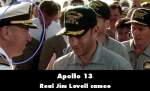
Correction: Not true at all. There's plenty of docking video and astronauts are not wearing suits in many of them.