Corrected entry: In the big sea battle scene when the slave rowers break out from below deck, you can see that one of them only has one hand. He wouldn't exactly be of much use to be fair. Also in the crucifixion scene, a prisoner is shown being lifted up holding on to the beam. Shouldn't the Romans have nailed him to it?
Correction: Most crucifixition victims were only tied to the cross, not nailed.
Corrected entry: Look out for the prisoner being crucified. He is having to hold on to the beam as it is raised, as the Romans forgot to nail him to it. He grimaces in pain anyway - a touch of overacting perhaps.
Correction: Most prisoners who were crucified were not nailed to their crosses. They had ropes tied around their arms to hold them in place.
Corrected entry: When the Trumpeters are beginning to play at the beginning of the Chariot Race you can see that one of the trumpeters is wearing a watch.
Correction: I've looked at this scene - frozen on pause - and I can't see anyone wearing a wristwatch. I think that this story originates from the old silent film version.
Corrected entry: Just before the chariot race, governor Pilate tells the audience that there are contestants from Carthage and Corinth taking part in the race. Carthage and Corinth were destroyed by Rome in 146 BC. The movie is set in the time of emperor Tiberius (14-37 AD).
Correction: By the time the movie takes place, both Corinth and Carthage were refounded and repopulated.
Corrected entry: There is a Holstein cow in the manger scene near the beginning of the movie. Holsteins were created through cross-breeding in Germany in the 19th century, so its appearance at Jesus' birth is impossible.
Correction: The Holstein breed is in fact over 2,000 years old and originated in parts of the world that would become the Netherlands. It is very conceivable that since dairy cattle were so in demand that a few cunning merchants could easily have traded for these cattle.
Corrected entry: When Judah (as Young Arius) visits Messala, he says "Find them (his mother and sister) Messala", then "I will come back tomorrow, don't disappoint me, Messala". Following that, Drusus goes to the Citadel and finds them as lepers, who are then released. However, Judah never finds out that they are alive or lepers until Messala's death speech after the chariot race weeks/months later. If he "came back tomorrow", surely he would already know their fate. He may have been told they were dead by Messala, but I'm sure they would have shown this scene as a vindication of disgust of Messala's character. I think they just forgot this speech.
Correction: The discussion never happens because Judah never goes back to see Messala. Miriam and Tirzah are released from the dungeon that night, go back to their home, and talk to Esther. Judah is actually in this scene, seen returning from his meeting with Messala. Miriam and Tirzah ask Esther to tell no one that they're going to the Valley of the Lepers, and that they'd rather she tell Judah that they're dead. It's Esther who tells Judah that his mother and sister are dead, and Judah, instead of going back to visit Messala, goes to visit the Sheik and begins training for the chariot race.
Corrected entry: The actor playing Jesus could not have his face shown as it was considered distasteful to do so according to the Hayes Code.
Correction: Actually, they did this because this was not a story about Jesus, per se, and by never showing the actor's face, it lent an air of mysticism to the scene. There is nothing in the Hays Code identifying that you couldn't portray religous people (including Jesus); you just couldn't portray them badly or in a light that riduculed the religion. The Hays Code was around until 1967 (replaced by the MPAA rating code) and one movie with portrayed Jesus extensively (The Greatest Story Ever Told) was made in 1965 - while the Hays Code was still around.
Corrected entry: In the scene where the rowers increase their ship to "ramming speed" and then hit the other ship, all the rowers fly forward. Anyone who rows knows that you row facing backwards, so they all would actually be thrown backwards by the impact.
Correction: On the DVD the rowers actually fly backward. I'm sure this was not different in the original movie.
Corrected entry: Gore Vidal, who worked uncredited on the screenplay, has said that he wrote the scenes between Judah Ben-Hur and Messala as if they had been former lovers. Stephen Boyd knew about this, but Charlton Heston didn't. Watch the first scene in which they appear together and pay close attention to Stephen Boyd. It all becomes very clear. Vidal, who is gay, has a reputation for writing sexually unconventional material.
Correction: The idea that Heston was unaware of any homoerotic undertone to the relationship with Messala is a popular misconception propagated by Gore Vidal in the documentary "Ben-Hur: The Making of an Epic" found on the DVD. It's interesting that Vidal is the only one to remember that Heston was fooled, but no one else has ever corroborated the story. In fact, in a book entitled The Films of Charlton Heston released in the 1970s, Heston himself says in an interview that the movie is 'a love story between Ben-Hur and Messala,' and that the love story between Ben Hur and Esther is secondary if not totally inconsequential.
Corrected entry: When the Sheik talks to Judah about the upcoming chariot race he says "...and then you'll defend, err, defeat him...". Since the Sheik's English (or whatever language English represents) is perfect except a slight accent this must be a lapse that survived editing. "Defend" is also skipped in the subtitles. (00:10:20)
Correction: The sheik does not say 'defend', but instead repeats, 'and then.' The scene referred to takes place in the Sheik's tent the night before the race. Judah is alone at first, 'bonding' with the horses, when the Sheik enters and says that he never thought his horses 'would love another as they love me.' He says to the horses, "Rest well, my children. Tomorrow, we go up to the city (Antioch, the site for the race)." He turns to Ben-Hur and says, "And then, Judah, and then, with the new governor there to see..."
Corrected entry: Early in the movie, when Messala visits Ben Hur, and tries to convince him to abandon his religion and follow the power of Rome, He says that the emperor is "real power on earth, not ..." and then gestures to something off-screen, which we never see. My guess is that the next shot showed the Temple, but was cut because it was thought to be too offensive to show as the subject of a disparaging remark and gesture.
Correction: Messala is not gesturing 'offscreen' in this scene, but toward the sky, implying that Caesar, not Judah's God, is 'real power on earth'. The dialogue exchange is as follows: Judah: You speak as if he were God. Messala: He IS God, Judah. He is power...real power...on earth. Not...(looks skyward and gestures)... Not that.
Corrected entry: Jesus Christ can be seen delivering the Sermon on the Mount in this film. The Bible states that he went up a mountainside with his disciples and talked to them. He did not deliver a lengthy sermon to a massive crowd on a small hillock.
Correction: Actually this 'mistake' is a misunderstanding, stemming from notes for Miklos Rozsa's (excellent) music score. Rozsa, in one of his early albums, called the cue for this scene 'Sermon on the Mount.' Indeed he actually SCORED the scene using the rhythm of the Beatitudes. The ACTUAL 'Sermon on The Mount' was delivered on Mount Galilee much earlier in His career ... indeed Esther claims in one of the love scenes that she HEARD it. THIS 'sermon' (the newer 'Rhino' issue of Rozsa's score on two CDs just calls it a 'Sermon') is a DIFFERENT one that takes place on Mount Olivet where Christ taught during Passion Week, when not in the Temple.
Corrected entry: In the big chariot race scene, a red Austin Mini can be seen through the arcs in the back of the coliseum.
Correction: Famous urban myth, and just plain made up.


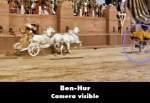
Correction: The man with the stump on the boat had, undoubtedly just received it while trying to break out of the cell. It's still bloody.