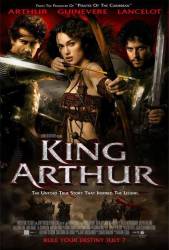
Factual error: I normally wouldn't bother with this sort of nitpicking, but this film specifically claims to be historically researched - and it's full of historical blunders. For a start, the film is set as the Empire withdraws its last troops from Britain - which was in 407 AD. Now Artorius Castus was a real Roman officer who really did command Sarmatian foederati at Hadrian's Wall, but he died around 200 AD. Cerdic was a real Saxon warlord who did go raiding the Britons with his son Cynric, but he did this in the early 500s. Pelagius really was tried for heresy, but he was acquitted and died of old age; the trial was a decade after this setting, and in the fifth century you couldn't be executed for heresy anyway. Also in the fifth century the Pope had no authority over Imperial troops. I could go on and on but that will do for now.
Revealing mistake: When Arthur is giving his speech before the last battle, in the background are three radio towers. You never know Arthur might need a radio to find out tomorrow's weather.
Factual error: In the beginning, which is around 400 A.D., it shows that the saddles have stirrups on them. Stirrups were not introduced in Europe until centuries after the fall of the Western Roman Empire.
Factual error: Tristan's bird of prey is a Harris' Hawk - a species native to the South-West United States and Mexico, and thus unknown and unavailable in Europe at the time the movie is supposed to take place.
Continuity mistake: In the scene where the knights are sitting at the round table near the beginning of the movie one of the knights has a plus sign shaped scar on his forehead. In the next shot,the same knight now has a sideways cross shaped scar. The scar changes almost every shot throughout the scene.
Continuity mistake: The knights reach the outpost beyond the wall. One of the knights reports to Arthur that the Saxons are approaching. During the exchange he's shown with his hair pushed off his face, then its covering one side of his face, then its off again.
Factual error: All the Roman troops wear armour and uniforms appropriate to the 1st century AD (the "classic" era most often depicted in illustrations). The film is actually set several hundred years later, by which time Roman soldiers looked very different.
Continuity mistake: During the battle at the end of the movie, the first wave of Saxon infantry is sent through the open door in Hadrian's Wall, and then it closes behind them. Mayhem ensues. All but one of the soldiers escapes after the Wodes fire arrows at them while the Knights ride them down. The single survivor staggers through the opening doors (which open just a crack, enough for the guy to slip through), and then stands there, and in that shot we see the doors behind him are now closed. An instant later, it cuts to the hillside where the Knights are standing on their horses looking down at the wall, and we see the doors both standing wide open. Scene cuts back, and we see they're closed again.
Plot hole: When the two Legionnaires open the gate of the Hadrian's Wall, they lean forward with their shoulders against the doors as if to push, but they are really pulling. (00:33:10)
Continuity mistake: When we see Tristan's bird for the first time, the shots changes between close up and distance. In the distance shot you see both of Tristan's arms out in the air, but in the close ups both before and after, it's only one arm out in the air.
Revealing mistake: At the beginning, when the Woads are attacking the Bishop's Carriage, Lancelot is hitting one of the Woads. The sword isn't even touching the Woad.
Revealing mistake: When Lucan draws the ring of dead Dagonet's finger, you can see the finger move and keep its position. (01:14:00)
Deliberate mistake: When Arthur follows Guinevere to the meeting with Merlin, her and the trees' shadows point at the viewer. Only Arthur has two shadows, one points to the left. The source of the moonlight is below the next ridge, and it's bright like a floodlight. Later, when Arthur is talking to Merlin, his face is always illuminated, even after a 180°-turn. (00:59:00)
Visible crew/equipment: When Arthur is riding with his knights in the open field, there's a front shot of the cavalry line. When the camera lowers down to where we can see the legs of the horses, the trail of the camera stage is visible on the ground.
Revealing mistake: In the shot where Guinevere and Arthur are kneeling over the slain Lancelot after the battle with the Saxons, you can see molded rubber soles on Guinevere's shoes.
Deliberate mistake: When the horses shy to get their masters back to Arthur's aid you can see Bors pull the reins to provoke that action. (01:28:35)
Factual error: The major Saxon invasion (the one we see in the movie) was set around 400 A.D. After a short time in the film, the battle of Badon Hill starts. This battle is thought to have occurred around 500 A.D. Arthur must be VERY old.
Audio problem: When the Woads attack in the beginning of the movie, after the knights have pretty much won the day, Bors hold up his fist knives, sticks out his tounge, and yells a sort-of war victory yell which sounds rather comedic. At the end of the movie when the knights and their horses charge into the Saxons out of the fog, you can hear Bors' exact same yell once again.
Continuity mistake: In the scene by Arthur's father's grave, Guinevere places her hand on Arthur's cheek. As the camera shot moves from front to back you see her thumb move from on his cheek to off again several times from one shot to the next.
Factual error: At the very beginning of the movie, the voice-over tells us it's around 300 AD. We see Roman soldiers, carrying shields and standards with the Chi Rho symbols. Those weren't introduced around 300 AD, but much later. Legend has it that emperor Constantine ordered his men to paint the symbols on their shields before a battle in 312, but Constantine's Arch in Rome, which depicts his victorious soldiers, doesn't show any of these symbols and the symbols in the movie are made of iron, not paint. (00:00:50)


Answer: Most of them are Friesian or Friesian crosses but but some are Andalusian.