Corrected entry: In the opening sequence, when Dana is in bed and hears Carol Anne say, "Hello, I can't hear you", for some reason there is a prosthetic leg lying across Dana's bed. (00:03:45)
Corrected entry: Steven lets Dr Lesh & Ryan in Carol Ann's room and the book comes close and the pages giggle at them. In slow motion with the book approaching them and laughing, at 1.5x slow motion you can hear Henry Kain's (the preacher) laughing, clear as day. You have to tweak with the slow motion.
Correction: The character of Henry Kain hadn't even been created yet at the time of filming. Hearing a voice that sounds vaguely similar to a character that appeared in a later sequel by manipulating the film's speed is not trivia.
Corrected entry: In the scene where Steven is talking to Robbie about thunderstorms and how far away they are; he goes from having his glasses on to having them off several times.
Correction: His glasses do not keep appearing and disappearing from his face. The scene starts with him having his glasses on. Then when Robbie says "it knows I live here" the second time, the camera shows the dad removing his glasses, and for the rest of that close up scene he has them off and in his hand. Until the camera shot changes to show Carol Anne, and the Dad is getting up off the bed, and has put his glasses back on, off camera.
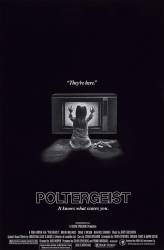
Corrected entry: When Carol Anne says her famous, "They're here!" line in her parents' bedroom, what she really appears to be saying is, "They're ALL here."
Correction: I can say "They're here" and have my lips look like it's saying the "all" part.
Corrected entry: When the son drives away, with the dog in a cab. The dog jumps into the back seat, but in the next shot it sits firmly on the front seat.
Correction: There is another shot between those two. That shot was long enough for the dog to jump from the back seat to the front seat.
Corrected entry: The bedroom door to the kids' room is always locked, but when the mother wants to open the door, she does so without a key. Later when the little ghost-clearance expert lady wants to go in, she finds the door locked and the father has to unlock the door with the key.
Correction: They only locked the door after the girl disappeared to keep people out. Not before.
Correction: The door was unlocked by the one scientist who went upstairs to investigate what was going on and ended up getting bit by something. The door was still unlocked after he left and was probably locked again later before Tangina arrived.
Corrected entry: When the parapsychologists are talking to the parents, Craig T. Nelson's character mentions that he is 32, and his wife is 31. And they have a 16-year-old daughter. Possible, but....
Correction: Actually, in the parapsych's interview, he says his wife is 31, then corrects himself and says she's 32. Craig never mentions his own age, but I once read that he's supposed to be in his early 40's, suggesting at least 1 kid possibly from a previous marriage.
Corrected entry: After Diane pushes back all the kitchen chairs around the clean breakfast table she walks past Carol Anne who is sitting on the corner kitchen counter. As Diane reaches under a base cabinet for cleanser and a rag, on the countertop above is the reflection of the waffle iron. You can see movement in the direction of where the table is as well as the snapping movement of the leaves of the tree behind the countertop TV at the same time. This is before Diane stands and turns to find the chairs suddenly stacked on the clean table.
Correction: The ghosts didn't teleport the chairs into the stacked position, they MOVED them. Seeing a reflection of this stands to reason.
Corrected entry: Robbie and Carol Anne share a bedroom, just to the left, and on an angle, of Dana's room (which is located upstairs, to the left, then directly ahead). This is obvious on a few occasions in the film (e.g. when the father says goodnight to them near the beginning of the film, and when the mother checks on them before having a bath near the end). At the end of the film when the poltergeist returns, the mother runs to rescue Robbie and Carol Anne from their bedroom - and bursts through the door to the left, and directly in front of her. Isn't that Dana's room?
Correction: You have look quick to see it but when Diane is running down the hallway, right before she is about to enter Robbie and Carol Anne's room, you can see the path to Dana's room. It's also visible in the shot right after the Diane, Robbie and Carol Anne spill out into the hallway as they escape the bedroom.
Corrected entry: In the scene where the chairs are stacked up on the table, while JoBeth Williams ducks under the counter to get something, you can see the reflection in the waffle iron of the crew moving around off-camera to manipulate the chairs. It can't be a reflection of the chairs moving because the chairs are light-colored and the shadows are dark.
Correction: The reflection isn't distinct in any way. You certainly can't identify them as human. Just because you know how the effect was accomplished doesn't exclude the possibility of an explanation within the fictional movie world. Perhaps there was some other poltergeist activity in the kitchen beyond the chairs. We see the ghosts move objects (chairs, the coffee pot, a steak, the piano) throughout the movie. Not to mention when they physically manifest themselves. The fact is that there are any number of story-related possibilities for the indistinct movement in the reflection.
Corrected entry: In the scene when Marty is watching the steak slither across the table, the steak is over one of the tile lines on the table (obviously there is a slit there and the steak is being moved by rods underneath.) After Marty shines the flashlight and the shot cuts back to the steak, you can see by the tile lines that it is in a different position.
Correction: Of course it's in a different position... it's moving! You're using your knowledge of how they made the steak move (which is more deductive than obvious, because no "rods" are visible) to guide your opinion of where the steak should be. But there's no reason to think the steak couldn't have moved to a different place while the camera was focused on Marty.
Corrected entry: Watch when Carol Anne and her mother are in the tub with the red goop all over them. The father rubs a wash cloth over the face of Carol Anne to clean off the goop and the unconscious child tries hard but her eyes squint.
Correction: The human body is still prone to twitches and reflexive movement even when asleep or unconscious. Perhaps dad was a bit rough with the washcloth and her facial muscles reacted. Not to mention that Carol Anne was starting to awaken.
Corrected entry: Right in the middle of the movie when a psychic tells about how haunted the house is (the evil force has kidnapped their daughter, and she's in TV land, as they can only hear her through the TV) She tells them what they will do to get her daughter back from the poltergeist. And she specifically tells them that she can only hear her mothers voice. Then in another scene she says to the parents "who is she more threatened by" and the mother says the father. So the psychic tells the father to tell his daughter that if she doesn't say anything she will get a smack. So of course the father tells his daughter that, but isn't she only able to hear her mother's voice?
Correction: First, Tangina never explains the plan to retrieve Carol Ann, she only explains what death is and why the spirits have targeted Carol Ann. Second, she wasn't being literal when she said that Carol Ann can only hear her mother's voice. She was trying to instill confidence in Diane, telling her that Carol Ann is alive and it's possible to reach out to her.
Corrected entry: "Mr. Rogers' Neighborhood" aired only during the week. It could not have been on at the same time as a Sunday-afternoon NFL game.
Correction: Not true. Many PBS stations run weekly shows during weekend hours. When I was a kid, I watched many of my favorites on the weekends. PBS stations are independently owned and can run whatever shows they like when they want to.
Corrected entry: At one point during the scenes where the mother is communicating with Carol Anne through the TV, the investigator asks her where Carol Anne was playing when she disappeared. The mother replies "In her bedroom closet." Carol Anne wasn't playing in her bedroom closet - she was in bed.
Correction: With all the toys in the closet, Diane may have assumed that Carol Anne had gotten out of bed to play.
Corrected entry: One end of a rope is tossed into the children's bedroom. It appears through the ceiling downstairs. The man downstairs is told to take up the slack gently. As we get an overhead shot of the man holding on to the rope, we can see the other end of it, even though that end is supposed to be by the bedroom.
Corrected entry: At the movie's beginning, why would the family bury a dead bird in a freshly planted flower garden, only to dig the whole thing up the next morning to put in a swimming pool?
Correction: This plot of dirt was moved by the people digging the swimming pool. They (the family) probably didn't originally want the garden to be dug up but in order to put in the pool, the workers had to.
Corrected entry: The main premise of the haunting, we are told, is that the greedy developer of Cuesta Verde has built the subdivision over a 300 acre cemetery that has had the headstones moved but not the bodies. Herein lies the problem. When was the last time that someone built a home, let alone a whole subdivision, without digging more than 6 feet down to excavate for sewer lines, water lines, basements, etc? Wouldn't someone, somewhere, have come across Great-Aunt Bertha's remains?
Correction: Cemeteries usually have lots of avenues and paths, so the developer could have laid out the subdivision so that the major utilities did not have to go through graves. He would probably only have to go through one or two graves per lot, and even those he would be just bumping them over a few feet (or just breaking them into pieces) rather than paying to transport them and dig a completely new hole. Obviously, he had to pay off some people in any case. He probably had illegal aliens do most of the digging, so they wouldn't tell. Houses in Southern California almost never have a basement.
Correction: But what about people buried throughout the US with no marker, or a marker that has disappeared over time? Many people were buried along trails of wagon trains, civil war, slavery, etc.
Corrected entry: My Spanish is a little shaky, but doesn't "Cuesta Verde" mean "it costs green"? Don't think I'd want to buy a house in a development that brags about it's priciness like that.
Correction: Actually, I speak no spanish at all, but according to freetranslation.com, it means "Green Slope"
Corrected entry: In the beginning when Steven's TV is being affected by the neighbour's remote control, what remote control can affect a TV in another house through their wall, across the yard, through the fence, then through the neighbour's wall?
Correction: An ultrasonic controller (or whatever they're called) can do so. I remember them from the late 70, early eighties.


Correction: It's just Dana's leg.
Yup, she just has it at an awkward angle, but it's 100% her leg. Not sure how the OP thought it was a prosthetic leg to begin with. There's literally no reason for a prosthetic leg to be in the shot when they could easily use the actress' leg, and it looks far too real to be a prosthetic from an 80's movie.
TedStixon