Question: I don't know whether this is a mistake or if there was a certain reason for it but, at the end of the movie when Maximus tells Quintus to free his men, Quintus turns to the line of guards standing behind him and says, "Free the prisoners, go!" Two of the guards standing next to each other immediately go to free the prisoners, and the rest of the guards don't budge. How did those two guards know that the orders were given directly to them?
Question: In regard to the scene in which Maximus (Russell Crowe) kills all the challengers and says "Are you not entertained?" can someone explain the people's silence before cheering? Why would they wait to cheer? Was it because they were so stunned at how good he was or insulted by how quick he finished it? It just seems very peculiar.
Chosen answer: You're probably closest with the suggestion that they're rather stunned at the sheer speed with which Maximus has carved through the opposition. They'd certainly be used to more of a show, so for Maximus to slay all his challengers in less than a minute would take them aback. If anything, the "Are you not entertained" is closer to the theatrics that they'd really expect to see, which would prompt them into cheering him - up to that point, he's not exactly won their favour, even though he's defeated all comers.
Question: Was Commodus and Lucilla half brother and sister? Wondering because of Commodus' attraction for Lucilla. Was incest normal at that time?
Chosen answer: No, they are full brother and sister. They both had the same mother and father. Incest was not exactly normal at that time, but it stretches back within the imperial families as far as Caligula and possibly earlier. There is no evidence to suggest that the real Commodus was attracted to his sister, it was probably just included in the film in order to make the character seem more disturbed, and also as another reason why he would be Maximus' enemy (Maximus and Lucilla were, after all, once lovers).
Question: I'm curious, why is it stated that the Tigriss of Gaul is the only undefeated gladiator? Wouldn't Proximo be an undefeated Gladiator, seeing as how he won the wooden sword? I do take in mind that Proximo could not be counted because he was set free, but could someone clear this up for me?
Answer: Gladiators weren't automatically killed on losing a fight - it almost certainly wasn't even the norm. As such, a gladiator could be defeated, but be spared to fight again and, if luck was with him, ultimately retire in some fashion.
Question: When Commodus lies on the bed with Lucilla, was he going to kiss her?
Answer: Depends on what you mean by "kiss". There are two ways one can describe his motives when he moves in on her. 1) he simply wants to give her a platonical good night kiss. 2) he wants a kiss that leads to something more. Commodus' signals toward Lucilla throughout the movie shows very strong passionable attraction from his side. Either way, whatever motives Commodus' "kiss" was, Lucilla despises her brother so much she leaves. And the conclusion, yes, he was going to kiss her.
Question: How did Commudus find out about Lucilla conspiring against him?
Answer: Commudus found out through Lucius (Lucilla's son). If you watch, at a certain part at the film Commudus sees Lucius fighting and asks him about becoming a legionary. Lucius then calls himself "Maximus The Savior of Rome". Commudus then asks "who said that?" and then Lucius, who whispers it in his ear.
Question: Why did Marcus Aurelius and Lucilla hate Commodus so much?
Answer: They don't hate him, particularly, he's family and, in their own ways, they love him, but they certainly don't trust him. He's unstable, unpredictable, arrogant, power-hungry, prone to conspiracy and ruthless. In a potential Emperor, that is not a good mix of qualities, as far as they're concerned, so they keep a very close eye on him and, as we see, Marcus Aurelius chooses to elevate Maximus in his place, something that unfortunately pushes Commodus over the edge.
Question: After seeing 'Gladiator' I looked up a few pictures of Tommy Flanagan (Cicero, Maximus' friend) and in all of them he has a noticeable mark on the side of his face. Is this a scar or a birth mark or something? Could someone please tell me?
Answer: He received that scar when he was attacked by a knife-wielding assailant outside a pub.
Question: Why are the eyebrows on Cassius, the master of ceremonies, so weird looking? Poking out and stuff.
Answer: It was part of his makeup. As the "ringmaster" or "M.C." of the games, he wanted to stand out and be noticed and remembered. The gladiatorial games were an extravagant entertainment spectacle that included participants who were similar to rodeo clowns, in addition to the gladiators themselves. Cassius was doing his part to be part of the show and maintain the spectator's attention.
Answer: They're not a feature of the character; they are David Hemmings' natural eyebrows. Perhaps he likes them, since they seem to be styled with some flair in and out of the movie.
Question: Is it true that there was a feud between Russell Crowe and Oliver Reed on set? And, if it is true, then what caused them to dislike each other?
Answer: It's basically true. Russell Crowe has a reputation for having an enormous ego and being difficult to work with. Oliver Reed was alcoholic and had an erratic and somewhat irascible nature, though he remained sober while filming. Crowe clashed with most of the Gladiator cast, including Reed.
Question: I just wondered if anyone knows how much of the historical content of Gladiator is accurate, e.g. are the characters based on people who actually lived?
Answer: Some of the characters are real - Marcus Aurelius and Commodus are both real emperors and were indeed father and son, but both are used in fictional ways. Marcus Aurelius did spend a lot of his reign fighting the Germans, but he died of the plague in Vindobona (now Vienna) rather than being murdered. Commodus did, in fact, fight in the arenas, but he did not meet his end there - in reality he was strangled in his bath by an athlete called Narcissus.
Question: Does Maximus kill Commodus with the same dagger that Commodus stabbed him with when he was chained?
Answer: Yes. After stabbing Maximus and later fighting him in the arena, Commodus knew that despite Maximus' weakened condition, he was unable to beat him especially since Maximus is a better fighter and Commodus was desperate to kill him. He took the knife that he used to stab Maximus with in hopes of succeeding but Maximus was able to turn the knife on Commodus instead.
Question: In the 'special features' there is a short movie made from excerpts and deleted scenes from the movie. Toward the end, Maximus is standing out on a cliff, and reaches out for something, then looks at his hand and yells. Could someone explain what was going on?
Answer: This scene is included in the extended version. This happens after he escapes and is on his way home to his family. He is most likely praying and reaching out in desperation to get home before the Romans kills his family.
Question: At the very beginning, why did the Germanic army just show up and do nothing, giving them time to prepare the catapults, archers and what not. Why didn't they just rush in as soon as possible?
Answer: Ancient armies would often line up for battle, exchange insults, taunts, and threats at each other, and either charge into battle or call it quits for the day, both sides retiring for the night. In "Gladiator", the Germans began forming up for battle after they sent back the headless body of the Roman emissary on his horse, while yelling defiant threats and insults at the Romans. So, the Germans weren't ready to attack until all their troops were ready for battle.
Question: I wonder, in what year is the movie set?
Answer: According to the opening text, the initial battle takes place in the winter of 180AD.
Question: To this day, I still don't know what the snake in the bed scene is about. Who's bed is it and who's trying to kill them?
Answer: Commodus had blackmailed Lucilla (by threatening her son, Lucius) into revealing all details in the plot to have him assassinated and he vows revenge on all conspirators, saying he would "Bleed the Senate dry." He sent his own assassins out in the night, who at one point can be heard declaring, "All enemies of the Emperor die!" A poisonous Old World Coral Snake was placed into the bed of Senator Gaius and his female companion, in the extended version of the movie two others were killed when the Praetorians set them on fire and, of course, Proximo was killed when other Praetorians set upon him in his room. Senator Gracchus's life was spared as he had been arrested earlier in the day based on suspicious activity, although it is likely had Commodus lived that he would have had Gracchus put to death, as well.


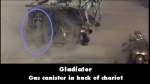
Chosen answer: Because they would be the ranking soldiers, and accustomed to being given orders. Being disciplined, they would obey Quintus without question. The legions would necessarily have soldiers assigned to following orders at different times, similar to how a captain would give an order to a full room, and the first mate would be the one to carry out the order.
rswarrior