Corrected entry: This is a fairly common error in many historical movies, and it glaringly appears in this one as well. Why are the knights wearing armor at nearly all times? This is uncomfortable, unnecessary and in the heat of the middle east, outright dangerous. It would also shorten the life span of the armor, which was also a fairly expensive purchase. The armor should be donned before a battle or if expecting an ambush, but stored otherwise. Wearing armor while traveling through Europe is bad enough, though perhaps excusable, due to raiders, robbers and whatnot. However wearing it while at a banquet in the castle in the Holy land is absurd.
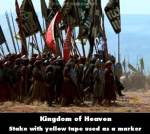
Corrected entry: In the scene where Balian of Ibelin is preparing the defense of Jerusalem and he sets white markers at a distance from the city walls, he measures this distance in meters. The meter was established in 1875 A.D, almost 700 years later.
Correction: Standard practice in historically set films is to use present-day language and terms, to allow modern audiences to understand - this is a standard movie convention and is not considered an error (the metre was actually first defined in about 1790). Regardless, in this particular film, the unit of measurement is never stated - they only ever mention numbers.
Corrected entry: Near the end of the movie, Saladin and his army arrive at Jerusalem around sunset. When night falls, they begin an offensive on the walls of Jerusalem with perhaps hundreds of trebuchets. This continues all night, and the next morning they assault the walls directly with siege towers and a ram. There are several things wrong with this set of events. Firstly, there is no way the army could have constructed so many siege towers overnight, even if they had the wood. Remember that they are situated in a barren and apparently treeless desert. Pushing the siege towers with them to Jerusalem isn't a plausible idea either, because they entered through the mountains-very unwieldy terrain to push something such as a siege tower. Secondly, if we are to assume they constructed siege towers on site, it would have taken weeks, perhaps months. There would be near-constant attacks on the walls with the trebuchets and the affected area would most likely be destroyed save the walls. This is why sieges were typically year-long affairs, and dramatic siege battles did not happen within days of the siege being laid. Also, it would not be logical or common for the besiegers to risk everything in a final struggle for a single breach in the walls. A sensible army would simply resume the bombardment and spend another few months building siege towers. The city might run out of food and starve, and the besiegers could take the city without further fighting. The developers most likely sped up the siege length for the sake of the movie, because it would be jarring to the viewer to skip forward months at a time.
Correction: According to historical accounts, Saladin and his army arrived at the city on September 20th 1187 and the surrender of Jerusalem was negotiated on October 2nd, thirteen days later. The accounts also mention the repeated use of siege engines of many varieties. So they either brought the siege engines with them, or were able to create them speedily on-site. While, yes, the filmmakers have compressed events to a small degree, this is simply artistic licence - the film is not intended as a documentary and thus is entitled to take liberties with the precise timeframe. Certainly the historical references do not support your assertation that the creation of numerous such machines should take weeks or even months. Your suggestion that the besiegers of the city would not concentrate all their force on a small area also fails to conform with the historical accounts. There are references to Saladin moving his army to a specific tactically-advantageous location near the Mount of Olives and opening a breach in the walls, much as depicted in the film, with an inconclusive battle being fought at that point. While the film-makers have taken some liberties, which is entirely allowable as artistic licence, the film sticks reasonably close to the true events.
Corrected entry: In the film, the dome on the Dome of the Rock is gilded with gold. However, the gold plating was not added to the shrine until the 1920s courtesy of a donation on behalf of the Turkish government.
Correction: While restoration has been necessary over the years, including the one in the 1920's, the dome has always had a gilt colouring.
Corrected entry: Far from letting the inhabitants of Jerusalem go free, Saladin actually ransomed those who could pay and enslaved the rest.
Correction: As stated in the disclaimer at the end of the film, although the story was based on real events and real people, some characters and events have been altered, added or left out for dramatic purposes. As the film-makers are specifically claiming not to be making a 100% accurate historical document, this is not a mistake.
Corrected entry: Guy de Lusignan was not paraded around by Saladin on a donkey. He was treated with honour and later released.
Correction: As stated in the disclaimer at the end of the film, although the story was based on real events and real people, some characters and events have been altered, added or left out for dramatic purposes. As the film-makers are specifically claiming not to be making a 100% accurate historical document, this is not a mistake.
Corrected entry: Balian was present at the Battle of Hattin, where Saladin defeated Guy, but managed to cut his way out of the encirclement and return to Jerusalem.
Correction: As stated in the disclaimer at the end of the film, although the story was based on real events and real people, some characters and events have been altered, added or left out for dramatic purposes. As the film-makers are specifically claiming not to be making a 100% accurate historical document, this is not a mistake.
Corrected entry: In the scene where Orlando is on the hill top where Christ was crucified, right when he stops talking, there is a shot into the valley where you can see a car going from right to left. Look for the head lights.
Correction: That's someone with a torch.
Corrected entry: Guy de Lusignan and Reynald de Châtillon weren't Knights Templar. Moreover, the Templars weren't allowed to marry. They were a religious order and took vows of celibacy and poverty.
Correction: It's fiction, so they can make anyone a Templar that they wish to. As far as the vows, Catholic priests take those same vows, but many (especially in that time period) chose to ignore them and marry and have children anyway. Many popes even had children.
Corrected entry: When Balian surrenders Jerusalem and walks back to the city, the dirt on his forehead changes a little.
Correction: Possibly he could have wiped his forehead.
Corrected entry: When Godfrey tells Balian how to get to Jerusalem he tells him to 'go to where the people speak Italian and keep going'. Italy and the Italian language did not exist at this time, instead people spoke various regional dialects which were formed into Italian circa the 14th Century.
Corrected entry: Count Raymond of Tripoli was the actual Lord of Tiberias. He did not refuse to accompany Guy and was present at the Battle of Hattin, but managed to cut his way out and escape.
Correction: As stated in the disclaimer at the end of the film, although the story was based on real events and real people, some characters and events have been altered, added or left out for dramatic purposes. As the film-makers are specifically claiming not to be making a 100% accurate historical document, this is not a mistake.
Corrected entry: Balian's father's name was actually Barisan, not Godfrey as is stated in the movie.
Correction: As stated in the disclaimer at the end of the film, although the story was based on real events and real people, some characters and events have been altered, added or left out for dramatic purposes. As the film-makers are specifically claiming not to be making a 100% accurate historical document, this is not a mistake.
Corrected entry: Just before the love scene between Balian and Sybilla, Balian is writing. In those days, a blacksmith would certainly have been illiterate.
Correction: He spent months travelling with his father to the Holy Land. He definitely had time to learn on the way just as he learned how to swordfight.


Correction: Wearing armour all the time was commonplace for soldiers at the time. They used it while travelling, eating, battles of course, and when around castles and keeps. It was dangerous and uncomfortable, but it was done as a matter of course. Many soldiers didn't even have "civilian" clothes, only their armour and undergarments, preferring to use the space in the backsacks and saddlebags for storing food, weapons and ammunition. In the Mideast at that time, it was more dangerous for soldiers than in Europe, since raiders, robbers and whatnot were in the Mideast, too.