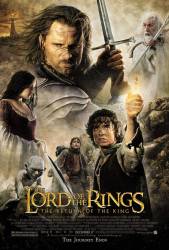
Question: I'm trying to find a specific part of a scene. All I can remember is the background is a forest-type set with possibly ruins or stairs. The four hobbits are there, but they're in their normal street attire. Any help would be appreciated as to which scene this shot is located.
Question: Is the Mouth of Sauron capable of seeing through his helmet? The design visibly does not incorporate eye holes, yet he nevertheless is able to accurately throw Frodo's mithril shirt at Gandalf and then recognizes Aragorn even though Aragorn does nothing to give away his identity, both conceivably would not be possible without keen eyesight.
Answer: We know very little about the Mouth of Sauron as he's portrayed in the film. While he's human in the book, his cinematic incarnation is of indeterminate species, so it's hard to say what he might or might not be capable of. The book version of the character is described as being a powerful sorceror - if the same holds true of the film Mouth, then possession of such strong magic could readily explain his ability to identify those around him and operate easily without eyesight.
Question: In FOTR, Bilbo says something like "There has always been a Baggins living at Bag End, and there always will be." Presumably he thinks Frodo, and Frodo's descendants, will always live there, but Frodo goes to the Undying Lands, leaving no heirs behind. In the book, Sam and Rosie move into Bag End, but this does not happen in the movie - at the end of ROTK, you can see that the hobbit hole Sam goes home to is not Bag End. My question is, why did the filmmakers change these 2 things? In other words, if Bilbo's line is supposed to make it important who ends up in Bag End, why not show who does end up there in ROTK? If it is not important who lives there (thus explaining why Sam and Rosie don't appear there), then why have Bilbo make a fuss over it in FOTR? I just don't understand what the point is.
Answer: Bilbo is simply stating the way things have always been. At that point, he has no reason to believe that Frodo and his descendants will not live in Bag End. As to Sam returning to 3 Bagshot Row instead of Bag End, having him go to Bag End would have caused some extra time to be added to the film. The film is long enough, and explaining that Frodo left Bag End to Sam and his family would've added too much unnecessary time.
Question: When this question was originally asked it was not clear enough, because the answer that was given is wrong and has nothing to do with the "emissary of Sauron's who's called "The Mouth of Sauron". Here is a more precise version of the question, so if anyone can please offer a response, it would be much appreciated. This question refers to the scene that Peter Jackson edited/chopped, when both Rohan and Gondor are at the Black Gate, and Aragorn is battling the Troll. Before the scene was edited, the Troll was originally the physical form of Sauron that Aragorn is fighting. How would this even be possible seeing that Sauron can only come into physical form once he has possession of the Ring? Likely the question answers itself, as that may be the reason why Jackson edited the scene and changed Sauron into a Troll, but am very interested in anyone else's thoughts about it.
Answer: Sauron's power is referred to as "growing" throughout the trilogy, so the initial rationale may have been that Sauron was ultimately able to gain enough power to reform his body, even though he still lacked the full power provided by the Ring. This would tie in to the books where, although Sauron never appears directly, there are a number of references that suggest that, in the book version of the tale, he possesses a physical form throughout. There's also the likelihood that it was originally felt that, dramatically speaking, a direct confrontation between the leaders of the two factions would be more satisfying to the casual viewer. Ultimately Jackson chose to revert to a story angle closer to that of the books, where Sauron remains a distant presence, plus, as you so rightly point out, it goes against statements made earlier in the film that Sauron requires the Ring to attain his power. As such, the fight against Sauron was reedited to pit Aragorn against a powerful troll instead.
Question: Can someone please explain to me the whole Rohan/Gondor relationship? I keep hearing that what is now Rohan was given to those who are now the Rohirrim by the king of Gondor.
Answer: That's true. The Rohirrim were a tribe of Northmen that had more or less settled just outside of Gondor. During an invasion by orcs and Easterlings in 2509, the steward of Gondor sent word to them and asked for help. Their leader, Eorl the Young, led the Rohirrim to the Fields of Celebrant, where they completely destroyed the orc army. In gratitude, the steward of Gondor gave them a large area of land as their own kingdom, that had more or less been depopulated by plague and the latest war. So Rohan and Gondor have had close ties and been allies ever since.
Question: Extended Edition: Why do the Army of the Dead try to crush Aragorn and others with the skull avalanche? They try to kill him, and then decide to help him. I don't get it.
Question: Gandalf doesn't need his staff to do magic, or does he?
Answer: This is difficult to answer. Tolkien, in the books, appears to tie the use of magic to the staff. There are several times that staffs are lost or broken and it is inferred that the Maia (the race, if you will, of wizards) is lessened by it. However, Gandalf is able to defeat the Balrog after he lost his staff at the chasm in Khazad Dhun. To do that, he needed his powers although he died in the process. So it doesn't seem that he absolutely needs his staff to do magic, but it certainly helps.
Question: I recently bought the Extended DVD of this movie and sold the Theatrical version to a friend. While watching the Extended DVD I couldn't help noticing that the jug that Pippin replaces the Palantir with (while Gandalf is sleeping with his eyes open) did not seem like the same jug as the one in the Theatrical version. Are they the same jug?
Chosen answer: There is absolutely no reason to believe it is not the same, the costs to change this would be prohibitive and there is no reasonable need to have done so.
Question: Does the Mouth of Sauron actually have Sauron's mouth, or is that just a name given to him because he is Sauron's messenger?
Chosen answer: The latter; it's just his title.
Question: Why could Eowyn and Merry defeat the Witch King when it seemed that no-one else could? It seems as though Eowyn can kill him because she is a woman but why does it make any difference?
Chosen answer: It was prophesied centuries earlier that no man could slay the Witch King. Since then, the Nazgul's power and martial ability have ensured that to be the case, however, it's also built up his arrogance and sense of invulnerability. As such, he fails to pay enough attention to his surroundings in battle, bragging to Eowyn about his supposed inability to be killed. This leaves him wide open for Merry, who he either simply didn't notice or never considered to be a threat, to take him down, then Eowyn to slay him. It's not so much that a man could not have slain him, more that a far-seeing elf looked into the Witch King's future and saw that it would not be a man who finally did.
Question: When Aragorn looks into the Palantir (Extended DVD) he sees Sauron (in bodily form) holding the other Palantir. Are we to assume that Sauron has regained physical form?
Chosen answer: No. Sauron's trying to psych Aragorn out, show him what he's up against. Appearing as the formidable warrior that he was before he lost the Ring is part of that.
Question: When Rohan arrives at the Pellenor fields, how come they are able to scare the orcs off so easily and force them back to the river (just before the Mumakil arrive)? In the overhead shot of the Rohirrim charging down upon the orcs, the orc army seems to outnumber them at least 5 to 1.
Chosen answer: It's not just about numbers. Sure, the Orcs may outnumber the Rohirrim, but think of it from the point of view of the individual Orc. Bearing down on them, at high speed, are several thousand heavily armed and fired-up warriors, each of whom is riding a warhorse that weighs more than several orcs put together and gives their rider a serious height advantage. Psychologically speaking, the Rohirrim have a phenomenal advantage. Hardly a surprise that the Orcs would break under that sort of pressure.
Question: Why release the Army of the Dead at the Pellenor Fields? Why not send them all into Mordor to destroy Sauron's entire army? Furthermore (this doesn't really count because it is about the book) why does, in the book, Aragorn just use the Army of the Dead to defeat the Corsairs and not even bring them to the Pellenor Fields?
Chosen answer: Purely and simply, Aragorn gave his word. The Dead would be held to their oath, nothing more. They came to the aid of Gondor, thus fulfilling their oath. Aragorn had no real choice but to release them; if he tried to keep them past the terms of their oath, he'd just have had a lot of annoyed Dead warriors to deal with. He can't compel them to continue to fight and he gave his word to release them once they'd fought to defend Gondor, fulfilling their oath. With that done, at Pelargir in the books, at Minas Tirith in the films, their oath is done. Aragorn had no choice but to release them.
Question: Extended Edition: Why do Faramir and his men expect an attack on Osgiliath from the North? Minas Morgul, the place where the orcs would come from, is South East of Osgiliath- wouldn't they expect an attack from there, especially after seeing the green beacon in the sky coming from there?
Chosen answer: Additional forces left Mordor via the Black Gate, marching to attack the elves in Lorien and the dwarven kingdom in the north. It would make a great deal of sense to send a group across the river at a crossing point to the north, then south towards Osgiliath to avoid the necessity of crossing the river under fire. With the main force attacking from across the river and the subsidiary force attacking from the north, Osgiliath would swiftly fall. Knowing that Mordor's armies are on the march, Faramir would be able to anticipate the likelihood of a northern attack.
Question: When Gandalf tells Pippin about the 'fair green country' is he referring to the Undying Lands (where Frodo goes in the end) or somewhere else? If he is talking about the Undying Lands, does that mean that normal people also go there once they physically die?
Chosen answer: In terms of the specifics, Gandalf may well be referring to the Undying Lands in order to boost Pippin's morale, but, no, non-Elves do not end up there without special dispensation. The younger races have their own destination after death, which Tolkien doesn't elaborate on to any great degree.
Question: When Gandalf finds out that Denethor is going to burn Faramir alive, why does he leave the battle just to save Faramir? Surely he could do much more good and save more than one life by staying in the battle.
Chosen answer: It's a morale thing. Denethor's already nearly ruined the defence of the city by telling everybody to flee; were it to become known that Denethor was not only dead, but had taken Faramir with him, thus destroying the line of Stewards and leaving the city with no ruler, the morale of the troops would be destroyed. Gandalf can only do so much to rally the troops; the city still needs a leader, even an incapacitated one. As such, he needs to make sure that Faramir survives.
Question: Is there any word about a new special edition of this movie with some deleted scenes on it? I would quite like to see the fight between Aragorn and Sauron at the Black Gate (which has reportedly been filmed).
Chosen answer: It's highly unlikely that that scene would ever see the light of day, as much of it was cannibalised to use in the fight between Aragorn and the Troll. Plus there would be substantial effects work required to present the scene in any decent way and it would be highly unlikely that the filmmakers would choose to do any more effects work at this point, just for a deleted scene. With three separate DVD releases of the film already in existence (theatrical, extended and the "special limited edition", which contains both the theatrical and extended cuts), it's highly unlikely that a fourth release would be under consideration any time in the near future.


Chosen answer: It sounds like a scene in "Return of the King" in the extended version, but it was the TWO hobbits (Merry and Pippin). Frodo & Samwise are still in Mordor trying to destroy the ring. The scene I think you're imagining is where Gandalf and gang come upon the destroyed Two Towers and find Pippin and Merry smoking pipes while sitting on a destroyed tower next to the forest. Hope that helps.
CCARNI ★