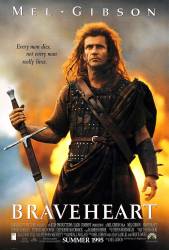
Corrected entry: Some more errors about Princess Isabella: at the height of William Wallace's rebellion Edward I sends her as an ambassador to negotiate with Wallace (and spy on the Scots) instead she falls in love with Wallace. Princess Isabella was born in 1292: Wallace's rebellion was at its height during 1297-8, so she could have been no more than 6 at the time. (Somebody else has already observed that she was only 13 at the time of Wallace's execution.) Isabella's first language would (obviously) have been French, a 13th century Scotsman would speak either a heavily accented Scottish version of English, or Scots Gaelic, but Isabella has no communication difficulties in Scotland. The Wallace-Isabella affair is also absurd, since it is implausible that, at the height of a war, an unaccompanied young woman, let alone a princess engaged to the heir to the throne of England, would be sent into the heart of a war zone as an envoy and a spy.
Corrected entry: At the execution scene near the end of the movie, the main executioner (the one in the red clothing) turns around and raises his hand to silence the crowd in one shot and then performs this exact same motion in the very next shot.
Correction: It's perfectly reasonable that the executioner would have to try and silence the crowd more than once; it was a large and noisy crowd.
Corrected entry: As the battle of Stirling draws to a close and Wallace is inspecting the carnage, two extras far behind him can be seen swinging their swords lazily at each other.
Correction: More likely that its a representation of two opposing soldiers absolutely knackered but neither going to yield. A fight to the death you could say.
Corrected entry: Near the beginning, when the Premiere Nocta is being administered at the wedding, the bride comes close to her husband and mouths, "I'll be okay; everything will be okay." It's touching, but the term "okay" wasn't around in centuries-old Scotland. (00:27:20)
Correction: Nor were almost all the terms used in the film: it is shot in modern English rather than the ancient forms of English and Celtic used at the time Wallace was alive. This is a straightforward film convention, not a mistake.
Corrected entry: At Stirling right before Wallace drops his sword and picks up an axe you can see some black duct tape on his sword. A man then swings his sword at the exact position of the duct tape. This is an obvious test take where they rehearse the scene, and was not meant to end up on screen. (01:27:00)
Correction: That's not black tape. It's a leather wrapping which covers the ricasso on the sword. It's meant to move.
Corrected entry: At the funeral of William's wife, you can see that she's moving her arms when the men pick her up to lay her in the grave.
Correction: Of course her arms move. She is wrapped with her hands on her stomach. When she is picked up, her back bends downwards which causes her thighs to push her hands upwards, towards her chest. The man who lifts her upper body also pulls the body towards him which gives the impression of her moving.
Corrected entry: At the beginning of the film, we see Murron hand William the thistle. They are both children, he is probably 5-6 years older than her. However as adults, William appears craggy and weather-beaten, while Murron is baby-faced and youthful. He is old enough to be her father.
Correction: Wallace works on a farm. That's heavy manual labor every day. Of course he is going to look older.
Corrected entry: The number of scars on Wallace's chest during the execution scene changes from two to four between shots.
Correction: Those are actually blood splatters from his stomach just being cut open and his intestines pulled out.
Corrected entry: When William goes back to his village, the surroundings consist of big mountains and deep valleys when, in fact, William Wallace was said to be from a village called Elderslie which is in the Lowlands. I live two minutes outside Elderslie and there are some nice hills around here but the nearest mountain is Ben Lomond and that's about half an hour away.
Correction: There is no definitive proof of Wallace's birthplace - tradition suggests that he may have been born in Elderslie, but this is based entirely on circumstantial evidence; other locations have also been suggested over the years. As such, no factual error can realistically be presented regarding the depiction of his birthplace.
Corrected entry: When Stephen and the other Scot come to join Wallace's army, watch Stephen as the other man speaks first, he has only slight beard stubble. As Stephen speaks and helps himself to food, he has suddenly grown a goatee beard, which stays for the remainder of the film.
Correction: This entry confuses two separate but similar looking characters. As Stephen and the other volunteer approach, Stephen is well behind and dressed in a multi-colored tunic. He does have the beard. The other character who has very similar facial features is dressed in a brown tunic and a kilt. When the volunteer reaches for the gift in his tunic, the man that looks like Stephen is the one that says, "We checked them for arms." Stephen is behind the volunteer and to his left, just off camera.
Corrected entry: When Murron is in the forest in William's dream, and she says "Wake up, William", a figure in black passes on one side of her briefly, possibly a crew member. It happens quickly but is noticeable.
Correction: Looks like nothing but fog behind her to me.
Corrected entry: When Wallace attacks the English to avenge his wife one soldier has his whole leg cut off - yet no blood squirts even though an artery has been severed.
Correction: Sometimes, if a limb has been severed quickly, the vein or artery can be sealed. Rare, but it happens.
Corrected entry: In the scene where Longshanks is returning from overseas, he enters a room to talk with Edward. As he enters, Longshanks hands off his crown to a servant. Camera flashes to a nervous Edward, then back to Longshanks. He once again hands off his crown to a servant.
Correction: The first time we see Longshanks hand his crown to the servant. The second time Longshanks is motioning for the servant to leave the room and close the door. The crown can be seen in the servant's hands. It is not passed twice.
Corrected entry: In the scene when Wallace is being transported to the execution, and people are pelting him with vegetables, at one point he gets hit by a cabbage or something square in the knackers, and you can see him wincing in pain and coming loose from his bindings.
Corrected entry: At the end of Murron's funeral as the people are leaving, William looks at Murron's parents. A white horse is clearly seen grazing over his left shoulder. The shot flashes to the parents and then back to William. The horse is gone.
Correction: It's true that the horse is gone, but that doesn't make it a mistake. To the right of the horse, you can see someone standing there. Presumably the owner of the horse, who attended the funeral and was now going home, taking his horse with him.
Corrected entry: This happens in the scene where William is hunting with the other men. After the Irishman saves William's life, he pulls his sword out of the guy he just killed. It is very obvious that the sword is only half a sword.
Correction: The sword is a short sword, usually only a couple feet in length, not a prop mistake. You can see the same length sword when the Irishman runs up and pulls it out.
Corrected entry: At the battle of Falkirk, Robert the Bruce is revealed to be a traitor fighting for the English. In reality, the Bruce was not even present at the battle of Falkirk and even if he had been, he would not have betrayed his people. He was as ardent a patriot as Wallace ever was and actually achieved considerably more for his nation.
Correction: We don't know if Robert Bruce was present at Falkirk. But if he was he propably supported Edward I - we are sure that Bruce's father commanded English garrison in Carlisle. Robert the Bruce is without any discussion one of the greatest Scottish heroes. But that does not make him a saint - before he began his fight for the Scottish crown he did change sides a few times. We can't also forget that he murdered his rival John Comynn in the church in Dumfries. To kill someone on the sacred land was very severe crime - he was excommunicated.
Corrected entry: When the Duke of York's head is seen in the basket, the Prince takes off the cover. However after the king has thrown Phillip from the balcony he sits next to thebasket with the head still in it. The cover has magically placed itself back on the basket.
Correction: Prince Edward is off screen for a while, and given that he was repulsed by the sight of the head, he likely could have covered it back up himself.
Corrected entry: In the scene when young Wallace first meets his future wife (at the funeral after his Father and Brother are killed) her eyes are blue. Yet, when she is older, you can see her eyes are brown, hazel at the most.
Correction: There are cases as when people get older, their eye color changes.
Corrected entry: After the Englishman slits Murron's throat, he wipes the blade, but there wasn't any blood on it.
Correction: Wiping the blade after using it was likely something he did as a reflex.


Correction: Her age has already been marked as an error. As someone well travelled, Wallace knew several languages and as an educated princess, Isabella would have likely known several (and this could all simply be a translation convention). And the king admits that he knew of the danger, and hoped that if Wallace or his men killed her, her father the King of France would help him defeat the Scottish rebellion.
Greg Dwyer
I concede most of your points, and, as you observe, if Isabella and Wallace can converse, this is 'translation convention'. Another error in the film that has already been marked: while the historical Wallace was a minor nobleman, Braveheart shows him as a common man, with no aristocratic or upper class traits, so the Isabella-Wallace romance forms a stock element of many romantic stories, a princess or prince defying social convention to fall in love with a lower class man or woman, entertaining as a story, but implausible in reality. And I think we agree that Isabella was only 6 at the time of Wallace's rebellion, so, in reality, she would have been far too young to have been involved in events.
Rob Halliday
First, both historical inaccuracies and things that you consider unlikely are not mistakes. Second, history is riddled with accounts of nobles having affairs with commoners and slaves.
Greg Dwyer