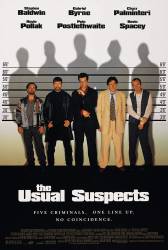
Question: How did Soze end up in the police station after he escaped the boat in the first place? If he had vanished after the bombing, he wouldn't have to make up the stories and he wouldn't have been identified by Kujan.
Answer: Soze ended up back under arrest and for some questioning as 'Verbal Kint'. He never really vanished, he's just playing two parts/people. He really vanishes off the scene by the end of the movie after he tricks Kujan.
With the exception of what's known to have happened on the dock, the entire story is a lie told by Verbal Kint to Agent Kujon. Kujon realises this after Kint leaves the office but not in time to catch up. The entire movie is about a habitual liar making up a story about what happened on the dock. He may be Keyser Soze or an alter-ego variant but even Keysers rep is subject to question as it was told by the same liar. Verbal himself said about Keaton, "He was a grounded guy, a cop. If you think the husband did it then you're right." He was telling on himself as sociopaths will do when they think they're smarter than everyone around them.
Question: While in interrogations Kujan is asking Verbal why Keaton told him to stay back while they were robbing the boat. After a back and forth conversation between them about it they come to the conclusion that it is because Keaton is Kaiser Sose and he wanted Verbal to be his will. However we come to find out this is not true, and Verbal is actually Kaiser Sose, so why did Keaton have Verbal stay back?
Answer: He never did. How they got on the boat and took out the Argentinians could have actually happened in a million different ways. For all we know, verbal went on the boat with them, and then killed them, which is more likely as it is an extra gun. The point of the film is to show how much of a mystery Keyser Soze is, that even after all of that, no one knows who he is. For example, he tells the story as if Soze is Hungarian and killed his wife and kids, but we know this isn't true, because Kint is Soze and he's American. The point is, he's telling so many lies and making up all these stories, so it's got to a point that they don't even know his real nationality. The only reason we though he was Hungarian throughout the film is because Kint told us, but we know his story was a hoax.
Answer: Verbal doesn't even know about some of the relevant facts of the story. He acts upset when Kujon asks about so and so when he in fact likely didn't even know about them so he continues to build on his epic tale of fabrications. The entire story is a lie of magnificent proportions.
Question: Why do the gang decide to kill Kobayashi (when they are dressed as repair men and shoot the other two men in the elevator)?
Answer: The gang decides to kill "Kobayashi" in order to get out of being forced into this dangerous gig, and also because the guy knows way too much about them (as shown by the personal dossiers they were given at the pool hall).
Answer: Because Verbal Kint is a sociopathic habitual liar and it fits his style of story telling.
Question: It is clear from the last scene that Kobayashi was not a made up character just his name, but what would have happened if McManus had killed him in the building? Surely that was not part of the plan. Also, was it Verbal at the start that killed Keaton? I saw the killer had a gold lighter, which may or may not be connected to the items Verbal later picked up upon leaving the police station. And if it was Verbal, then why didn't Keaton look for an exclamation because wouldn't Verbal have fooled them also with his "act".Did Verbal kill the other usual suspects?
Chosen answer: McManus could have killed "Kobayashi", it's true, but any plan has an element of risk. By bringing in Edie Finneran to consult on the case, they're making it clear to Keaton that any deviation from their wishes will result in her death, relying on his feelings for her to get him to force the others to toe the line. Kobayashi then forces the issue further by revealing what he knows about their families, making it clear that, if they kill him, their loved ones will suffer. While much of the truth behind the film is a little fluid, it does appear that Verbal was indeed Keaton's killer - when he finally sees his attacker's face, Keaton's look of disbelief followed by resigned acceptance would seem to indicate that he's finally figured out what's been happening, that he's been manipulated from the start, but the realisation is too late for him to do anything. As for the other three "suspects", it seems likely from what's shown in the film that Verbal killed Hockney and McManus personally. Who killed Fenster is somewhat less obvious; most likely he was slain by "Kobayashi", or agents working for him, after he tried to run.
One little note: close inspection shows Kevin Spacey behind the gun that kills Keaton.
It not, it's Gabriel Byrne. Dean Keaton.
Question: Plot spoiler. I don't know if this is a plot hole or if it's an error on Söze's part, but wouldn't the story he told the cop pretty much make killing the guy who could identify him irrelevant? Söze wanted him dead because he was the only one willing to identify him. But after the conversation with the police officer the cop would know that Verbal Kint was Kayser Söze. Thus his identity would be out in the open (lots of people seemed to know who Verbal Kint was after all). Did Söze just not think the cop would figure it out, is it a plot hole, or am I missing something?
Answer: Verbal doesn't really care. All he needs to do is keep Kujan occupied until he posts bail, then he's out and away. So he spins his story until he's free to go, putting in enough truths to keep Kujan interested and play up to his theory that Keaton might be Söze, then just walks straight out of the building. Once he's out, he vanishes back into the underground from where he came. Job's done, the only person who could positively identify him is dead. All that remains is a picture that resembles Verbal that might be of Söze, from a terribly-burned witness who might not survive anyway (and Söze would have the resources to eliminate), a sealed testimony that's mostly a lie anyway and a conversation full of falsehoods with a known con artist. None of which would stand up in court as a positive identification, good enough to convict. The police will want to have a word with Verbal, sure, but Söze's got enough experience at vanishing that they'd never find him. Nothing remains to identify and incriminate Söze, which was his aim. The whole affair just joins the increasing list of stories surrounding the quasi-mythical figure of Keyser Söze.
Answer: The guy killed on the boat not only knew what Soze looked like but claimed he could expose "all of his operations." That latter fact was much more important from Soze's point of view than knowing his face. The cost of getting rid of the "super-grass" was that the cops now know what he looks like, that's all. Appearances can easily be changed.
Answer: Verbal Kint says himself that in his opinion, Soze will disappear back underground forever. He literally told them what he was going to do.
Answer: It didn't matter anyway as they say at the beginning of the movie he was granted full immunity for his testimony so even if they figure out he is Soze they can't prosecute him for any crime as it would be covered by his immunity deal.
Question: Why did Keyser Söze (Verbal Kint) plot to kill/eliminate all the 'Usual Suspects'?
Answer: Each of them has unknowingly crossed him in some manner. So he pulls them together into a group, uses them as pawns to help him eliminate the man who can identify him, then, once that's done, he cleans up the loose ends by taking them out.
Answer: We cannot assume that the suspects crossed Keyser in any way as we cannot assume any of the story is true, therefore it could be because they crossed him or simply because they know his face.
Question: Is Keaton really as bad as Kujan says? Did he really kill all those people and set up all those deals? He didn't seem so bad to me.
Answer: What we're seeing in the film is a Keaton who's trying to reform, inspired by his relationship with Edie Finneran. Kujan has no particular reason to lie about Keaton's earlier exploits and it certainly seems from what's said in the film that Keaton was a major criminal in his time. True, many of these statements are taken from Verbal's tale, so they cannot be taken as being definitive, but they must contain a reasonable element of truth or Kujan, who is clearly familiar with Keaton's file, would have picked up on it.
Answer: While mostly accurate, there is one non-applicable element to the Chosen Answer on this one: everything Kujan says about Keaton is not part of Kint's fairy tale, as he is in the real world.
Question: Sometimes it's difficult to tell which events are real and which aren't. Which events actually happened, and which ones did Verbal make up?
Chosen answer: There's no particularly good way to tell - one good rule of thumb is to consider which events the police would be able to quickly check themselves. So, for example, Verbal's description of the attack on New York's Finest Taxi Service would have been substantially factual, as he wouldn't want to risk contradicting anything that the police might have found out from witnesses. Likewise the deaths of Saul Berg and his bodyguards would be largely correct. The most likely scenario is that large parts of what Verbal says are reasonably close to the truth - by doing that, it would make it easier for him to stick to a consistent story.
Answer: I believe everything is factual up to the point they go to L.A. Agent Kujon confirms the lineup and taxi service bust.
Question: At the start of the film, when Soze kills Keaton, the camera pans to the piles of rope that, later in the film, is shown to be the hiding place for Verbal as he 'watches' Keaton get shot. As Verbal is later found out to in fact be Soze, what is the significance of the rope, surely no one is hiding there? As Verbal is the one that is shooting Keaton? Was there someone else hiding that we don't know?
Answer: So I think the movie is implying that Verbal is behind the ropes, which later we learn is a lie. So I guess that shot is thrown in to keep the audience fooled. Also, if Marquez is the only one who knows what Keyser looks like, how can the burnt Hungarian describe him after the boat blew? Because he was not behind the ropes watching, he was in a drain pipe.
The Hungarian described him because he was on the boat killing guys. Verbal wasn't in the drain pipe, that was Marquez Remember they found him tossed from the boat in the drain pipe with 2 gunshots to the head.
Answer: Every visual from Kint's tale isn't 100% believable...that's just where Kint said he was hiding. He was actually killing the crew and the witness at that point.
Question: Why does Keaton ask Soze/Verbal in the opening scene what time it is? I read somewhere that in the DVD commentary it's said that Keaton placed a bomb somewhere on the ship set to midnight, but the scene was cut. But if this is true, why was the time 12:30 when Keaton asks and why even keep the line where he asks the time if they didn't keep the scene with the time bomb?
Question: OK, so I get nearly everything in the film except one thing. Who is the man in the hospital (60% of skin burnt) and how does he know the portrait of Keyzer Soze. Doesn't that mean he saw his face? Also they say there is another guy who escaped the fire unharmed. Who is that?
Answer: One of the Hungarians from the ship who survived the fire. He's the only person left in the world who's seen Keyser Soze's face. The unharmed guy is Verbal Kint.
Answer: Keyser Soze, being built up as the meticulous mastermind that he is, would not have gone through all that just to kill the wrong guy. The man he shoots in the head twice is the only man who can ID him. The cops found that body and identified it as the rat who named 50 criminals including Soze. The Hungarian with the burnt skin likely was one of the people buying this guy from the Argentinians. He was on the boat when it blew up and saw the true events of what happened that night (Verbal killing Keaton and presumably everyone else). Considering the fear and mystery shrouding Keyser, it's a pretty easy conclusion to make that the only man who survived, the man he witnessed kill everyone, was Keyser Soze. The Hungarian becomes the only man to be able to identify Soze (a mistake on Verbal's part for unknowingly leaving a witness), but by then it doesn't matter. Verbal/Soze said it himself; he wouldn't come this close to getting caught and then stick his neck out again. He's gone.
Answer: The man in the hospital is "The Man" the Hungarians were protecting...he is the man that knew and could ID Keyser Soze. Now back in the boat Keyser shoots twice in the head a man that was being protected. This was was a decoy. You find that out when they say they pulled a man from a drain pipe...the real one didn't speak English, only Hungarian, and he ran for it once the fight erupted.
The guy shot on the boat wasn't a decoy. It's the same guy we saw Keyser Sose let go in the flashback. The burnt guy was one of the soldiers who fought them, saw Keyser Sose's face, but didn't manage to escape the following explosion, although he survived.
Question: At the start of the film we see Keyser Soze kill Keaton and then set fire to the boat and walk away. If he has already accomplished all his goals (killing the witness and killing the 3 remaining thieves), why do we see him later as Verbal Kint in the police station? Why wouldn't Keyser Soze (a mastermind) simply have escaped into thin air after he blows up the ship?
Chosen answer: He needed to give the police SOME kind of explanation for all the violence at the harbor, or it would have become a big mystery like Jimmy Hoffa or Amelia Earhart's disappearances that people are always trying to solve, and then someone may have discovered more truth than he wanted. As Verbal he could tell a story to the police that implicated Keaton as Soze and he could disappear again.
Question: Why was Benicio Del Toro's character killed in the film, what was the point if he was doing the job as well, surely it just makes it harder with less men?
Answer: Fenster was running away, making it entirely clear that he had no intention of going through with the job. As such, he was killed, both as revenge for crossing Soze and to make it clear to his erstwhile cohorts that attempting to flee was not a viable option.
Question: At one point during the interrogation Fenster says "he'll flip ya, flip ya for real..." https://www.youtube.com/watch?v=Rntm3yDAQuM. I recently watched a documentary about Thelonious Monk in which he makes a near-identical statement at 1:07:41 - https://www.youtube.com/watch?v=D9udeWOjjls. Was either the actor or director making a reference to the musician?
Answer: From what I've heard much of Fenster's dialogue was ad-libbed by Benicio del Toro, so most likely he'd seen the same documentary, or is a Monk fan and came up with that himself.
Question: I'm a little slow on drug slang, so is the drug on the boat cocaine or marijuana? I'm pretty sure it's cocaine as 91,000,000 dollars of marijuana sounds a bit ludicrous, but it's referred to by Kujan as Dope, which in the UK means pot/marijuana. Could someone correct my slang and tell me what is on the boat?
Answer: In US police parlance, particularly for the era of the film and the age of the DEA agent in the film, any kind of drug, including marijuana, cocaine, heroin, barbiturates and LSD were referred to as "dope".
Question: Verbal is presented as a person who has worked with Keaton presumably for some time to have earned his trust. But since Verbal is really Keyser Soze, this would mean that Soze had been "underground" as Verbal for quite awhile establishing his relationship with Keaton. Can we really expect that Soze would have been "playing the part of Verbal" for the length of time, presumably years, he would need to in order to establish a bond of trust with Keaton? And what could have been Soze's original motivation? It couldn't have been that he foresaw this particular situation that he was going to need a criminal of Keaton's caliber to help pull off. The relationship with Keaton would have had to have begun long before Keyser Soze would have known that he needed Keaton to assist in pulling off this particular job. So why establish the relationship with Keaton in the first place?
Answer: Soze, as is established in the movie, tends to work anonymously or through intermediaries, with the result that, generally speaking, those working for him are unaware of their actual employer. But Soze still needs to keep informed about players and events in the criminal fraternity, so it makes reasonable sense that he would have a number of fake identities that he could use to keep tabs on things directly when necessary. Soze has, as is stated in the movie, encountered Keaton previously in his "Verbal" persona, although Keaton specifically states that they've met "once or twice before", which suggests that they haven't actually worked together. It's not necessary for Soze to have spent years underground masquerading as Kint for this to be the case, just that he use the persona on those occasions when he was in the right area. During those occasions, he encountered Keaton, probably to evaluate him for use in a future operation after Keaton interfered with his earlier smuggling operation.
Answer: They were briefly in lockup together months earlier where Kint got a "6 month suspended sentence" as divulged early in the film. Kint does leverage this brief relationship to secure Keaton's spot on the team. But why go to such lengths to secure him? Because he felt the storming of the ship was a 5 man job, and he knew Keaton had several murders along with a storied past in his history that made him a reliable and strong team member.
Question: What does Verbal Kint leave the police station with?
Question: How does Arturo Marquez end up on the boat in the custody of the Argentinians?
Answer: Marquez was the one that Keyser Soze let go after he killed his family so that he could tell the story. Presumably, he ran far from Hungary to flee Soze's wrath and ended up going to the Argentinians for protection.
Question: What was the point of Kint using names on the wall and coffee cup if he already had a story he told to the DA that checked out? He started using them before Kujan found out about the person Keyser Soze.
Answer: Kint (Keyser Soze) was toying with the cops, using names within the interrogation room to see if the cops were really paying attention, who were so engrossed in the story of Keyser Soze they did not see what Kint was doing or the clues being offered to them, such as throwing out unrelated bits about him being in a barber shop quartet in Skokie, Illinois, which was on the dry-erase board in the interrogation room. That the cops did not get the clues until after he was released and escaped much later demonstrated how Keyser Soze could control whatever situation he was in, including outsmarting experienced veteran police detectives.


Answer: Kint/Soze ended up in the police station because he simply didn't get away in time.